Product gallerySynthetic data — no patient information

See ChironAI at work.

The rest of the site tells you what ChironAI does. This is what it looks like doing it — the agentic clinical Operating System, captured from the working products. Two editions, both in market: CDS runs the encounter; OM runs the whole California workers’-comp claim. Every screen is a real product surface. Powered by Eve-Healthcare™ F5/reasoner.

A note on the data

Every screen shows synthetic data — no patient information. These captures run on a synthetic demonstration record generated for this purpose. No protected health information (PHI) appears anywhere in this gallery.

ChironAI™ CDS · Clinical Decision Supportcds.chirongrid.ai

Chiron runs the encounter.

Generally available for hospitals, clinics, and health-sciences institutions. Chiron gathers the record, reads the labs, checks safety, reasons the differential, and drafts for the physician to attest — every step visible, nothing entering the chart unsigned.

The encounter

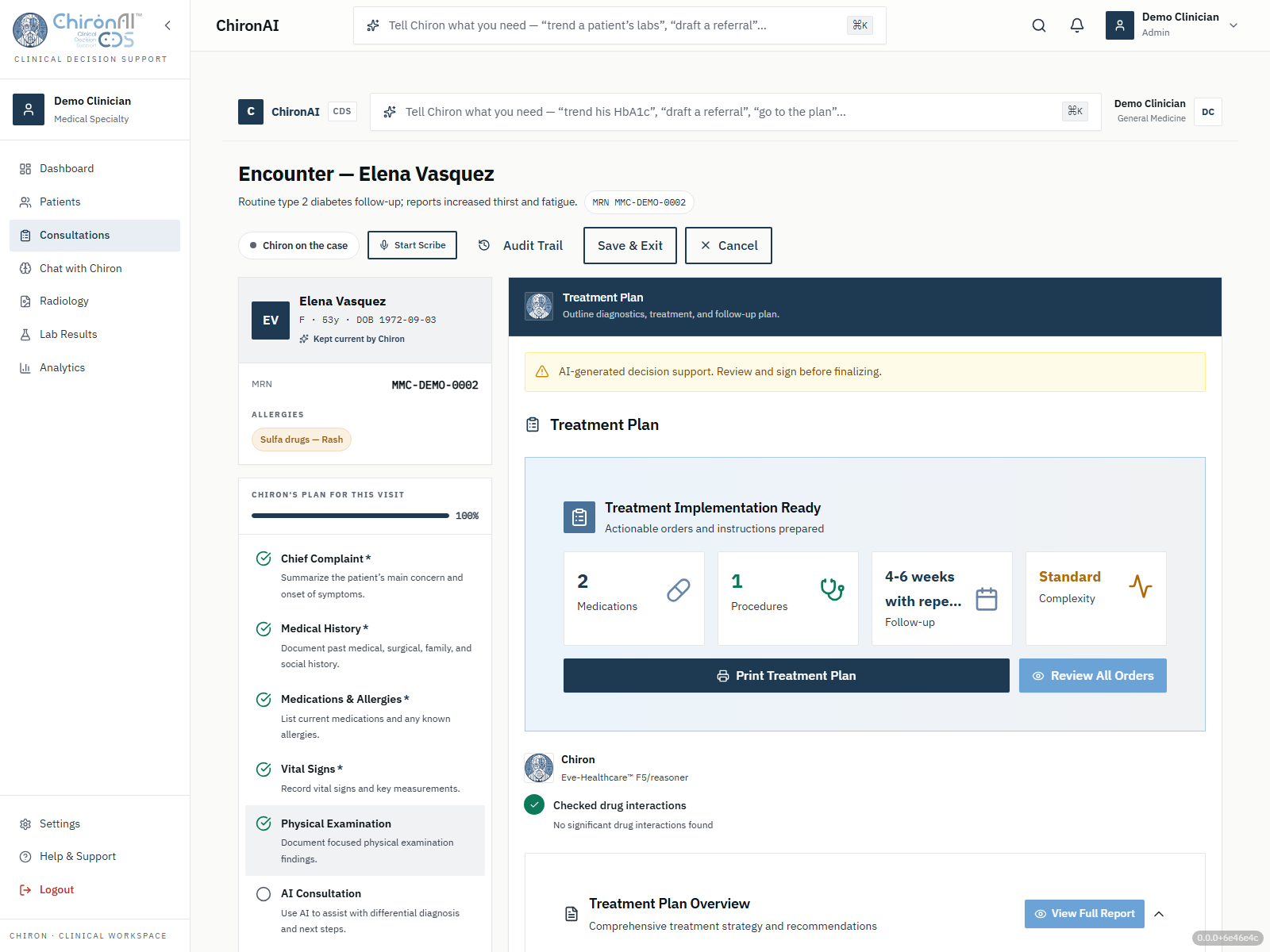
You give the command. Chiron runs the plan.
cds.chirongrid.ai
The CDS encounter — Chiron’s command bar, a live agentic plan with visible tool-calls, streaming reasoning, and a draft assessment staged for physician attestation.
The encounter is not a form. You state the intent; Chiron builds and runs a live plan — reading the record, checking the labs, screening safety — with each named tool-call visible and the reasoning streaming as it happens. Every artifact lands as a draft for the physician to attest. Powered by Eve-Healthcare™ F5/reasoner.
Chiron is working

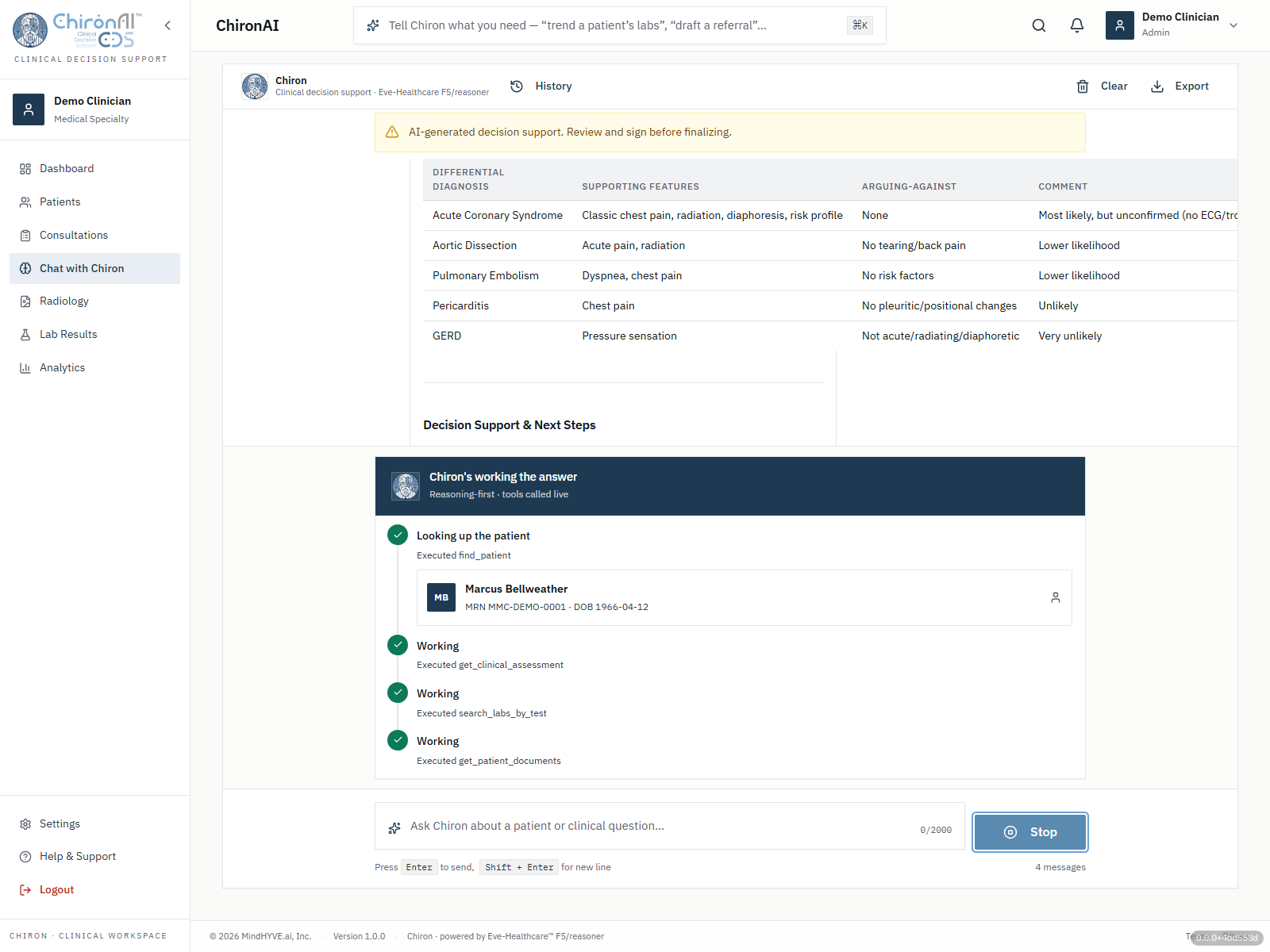
You watch the thinking, not a spinner.
cds.chirongrid.ai
CDS streaming reasoning — Chiron’s clinical reasoning rendering live, token by token, across a clinical touchpoint rather than behind a spinner.
Reasoning streams live across eleven clinical touchpoints, the copilot chat, and even while a study is being read. The differential is reasoned in front of you — the weighing of anemia against early heart failure, the data that shifts it — so you can follow the logic and catch where you disagree before anything is drafted.
The differential

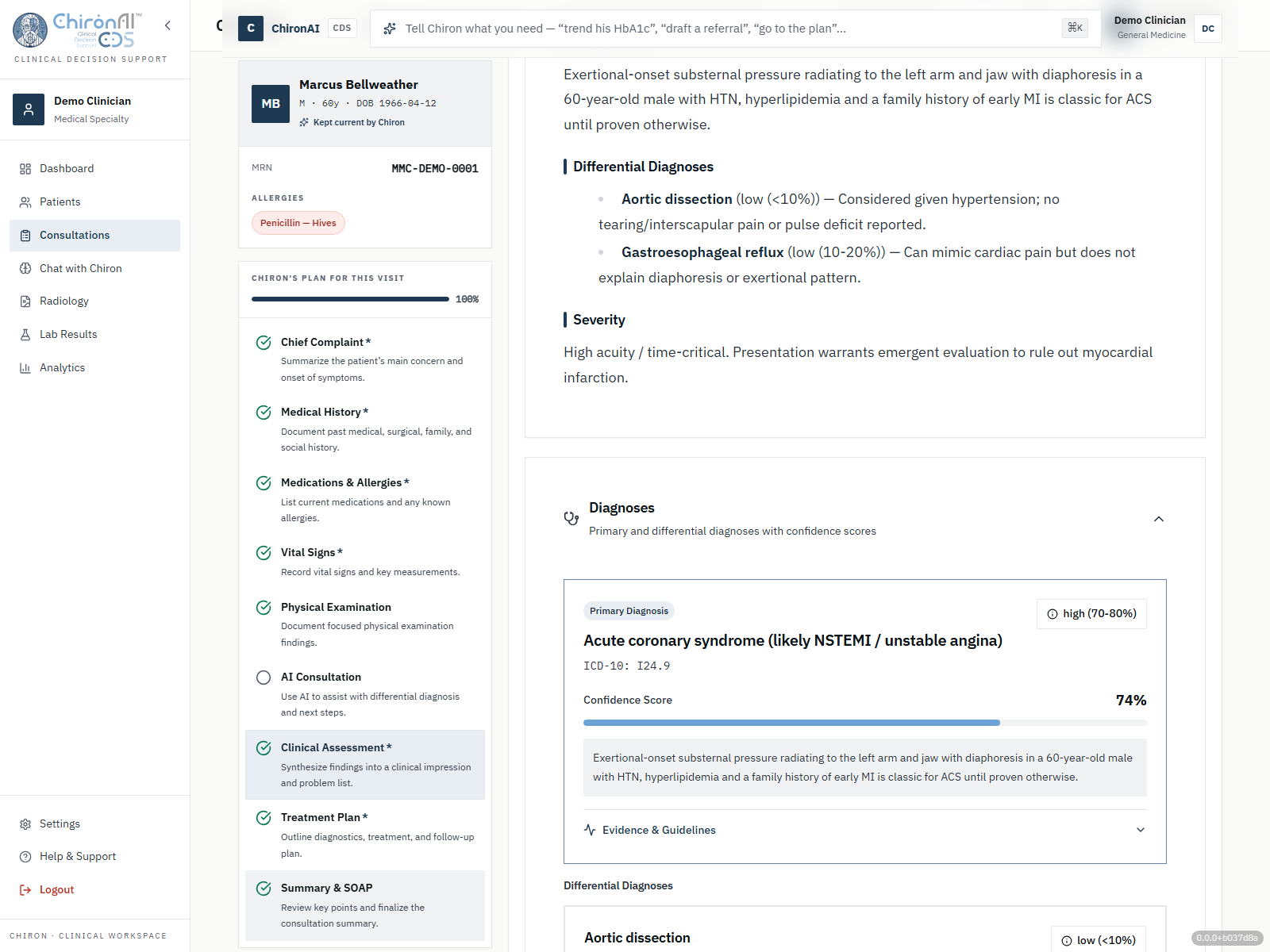
A differential that says how sure it is — and when it can’t be.
cds.chirongrid.ai
The CDS differential — a ranked differential diagnosis with a six-tier confidence scale and Bayesian percentages, including a first-class “cannot exclude” state.
Causal reasoning over the presenting features, ranked with a six-tier qualitative confidence scale and quantitative Bayesian percentages — each with an auditable trace through the underlying evidence base. “Cannot exclude” is a first-class state when the data is insufficient, not a forced guess.
Labs you can trust

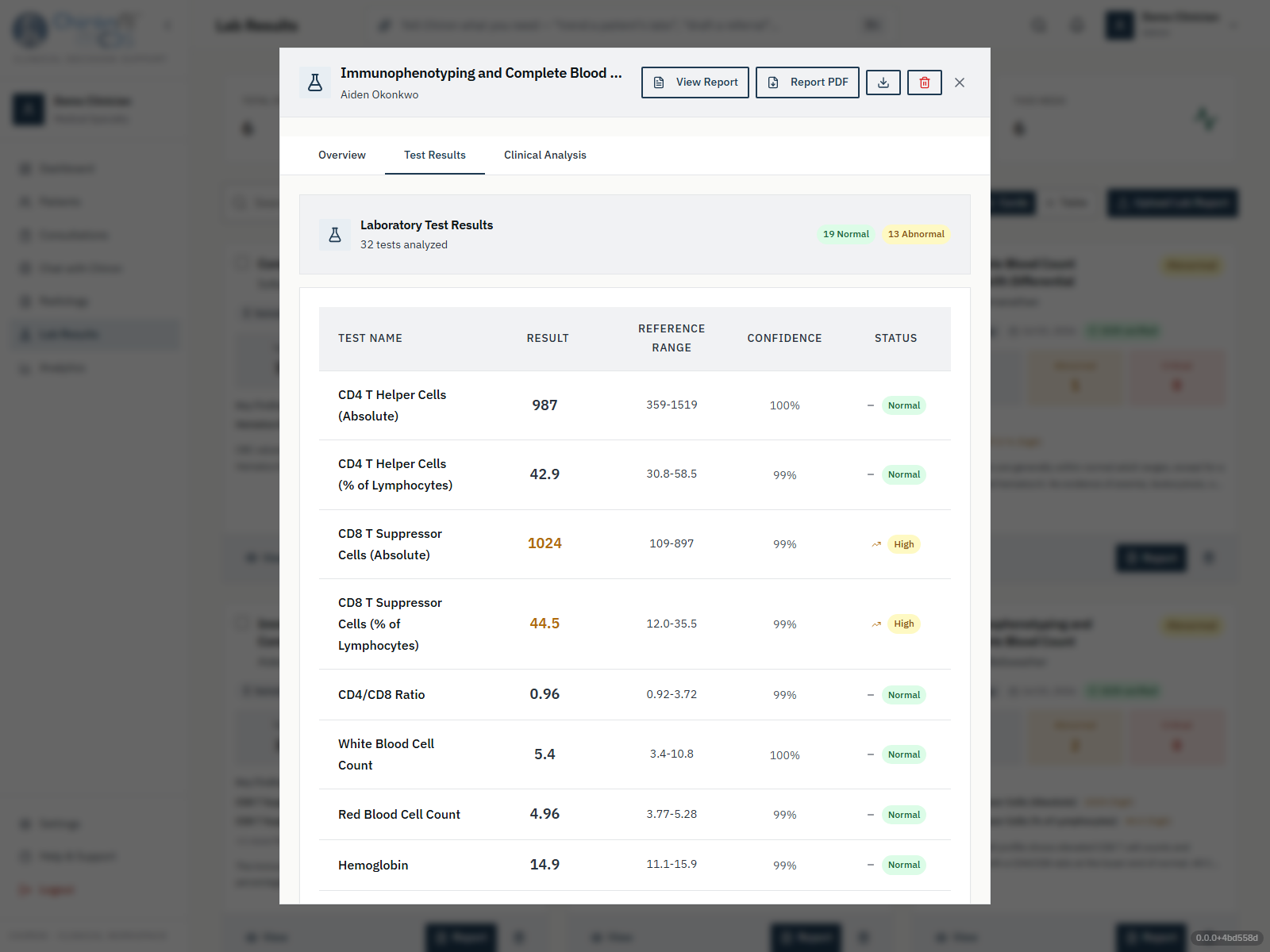
The numbers are read from the report, never invented.
cds.chirongrid.ai
The CDS labs view — lab values extracted ground-truth from the source report, matched against the pattern library, with critical-value cutoffs flagged.
Lab values are extracted ground-truth by Azure Document Intelligence directly from the source report — a deterministic layer, separate from the reasoning engine. Chiron matches the panel against thirteen canonical patterns and twenty-two critical-value cutoffs and flags what crosses the line. Chiron may label and interpret a value; it cannot invent a digit.
The read

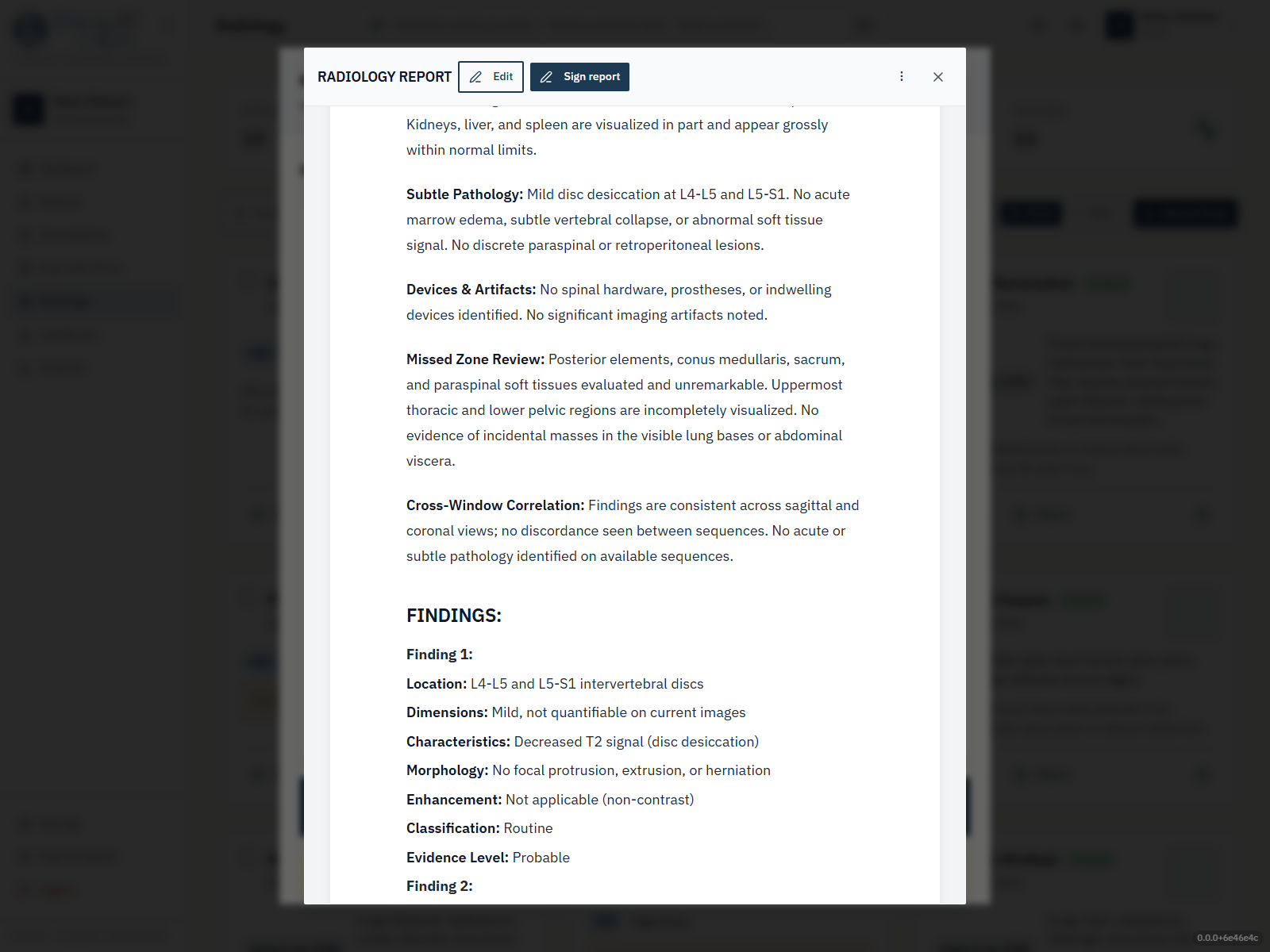
A five-pass, framework-aware read — drafted for attestation.
cds.chirongrid.ai
The CDS radiology read — a framework-aware, structured multi-section report from a five-pass read, drafted for radiologist attestation.
The radiology workload runs as a five-pass structured read with explicit cognitive-bias counter-measures and around thirty-five named frameworks across nine RADS systems (BI-RADS, LI-RADS, PI-RADS, and more). Each pass carries its own evidence trace, and the read resolves into a ten-section report the radiologist reviews and signs. Red-Alert discipline for critical findings.
Documentation

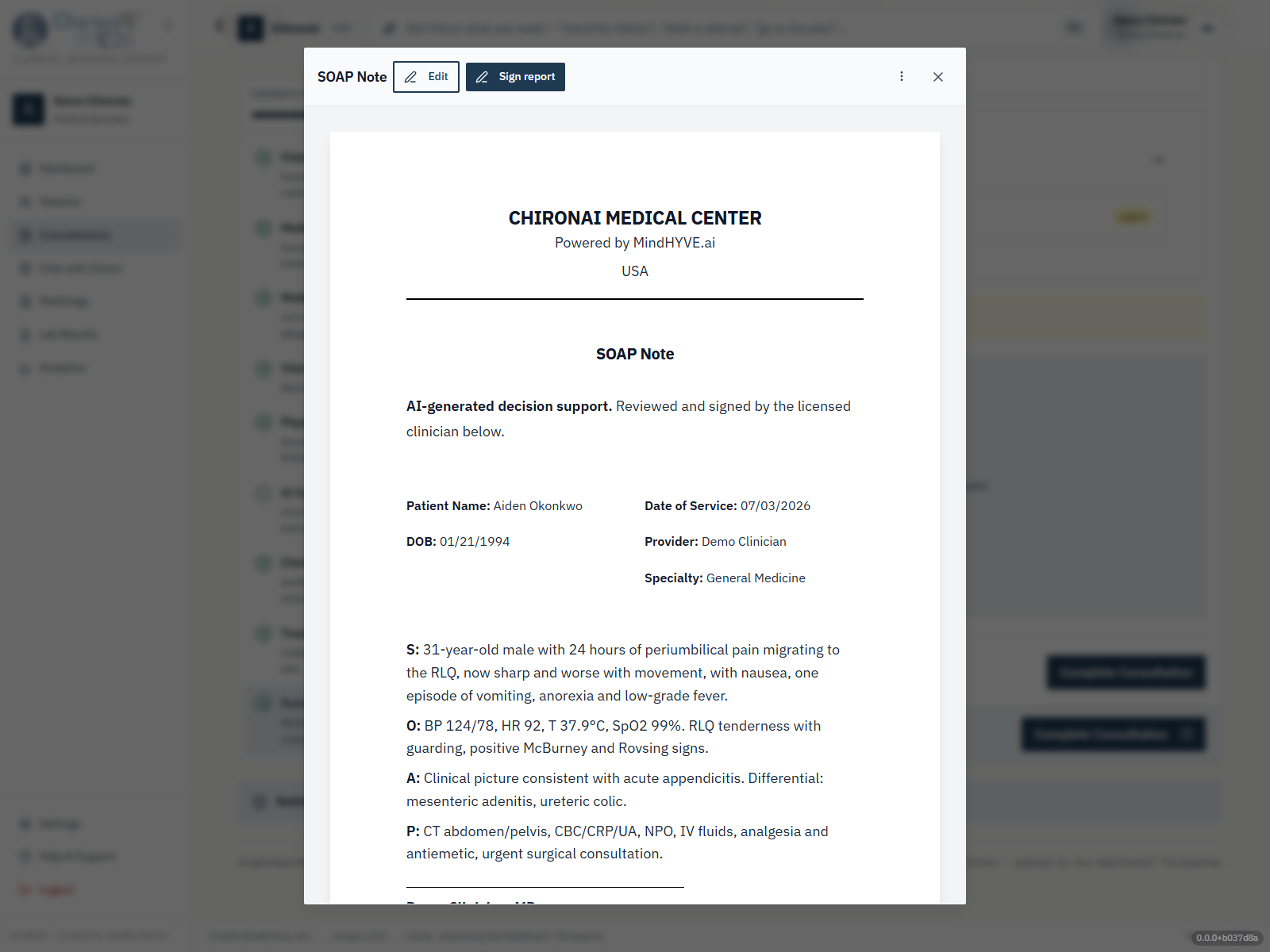
Every line of the note traces to the chart.
cds.chirongrid.ai
CDS source-grounded documentation — a generated SOAP note where each statement links back to its source field, source value, and source date in the chart.
The generated SOAP note is source-grounded: every statement is traceable to its underlying source field, source value, and source date in the chart, and the audit chain stamps the trace. Twelve locales out of the box, with RTL support — the note meets the patient and the record where they are.
Prescribing

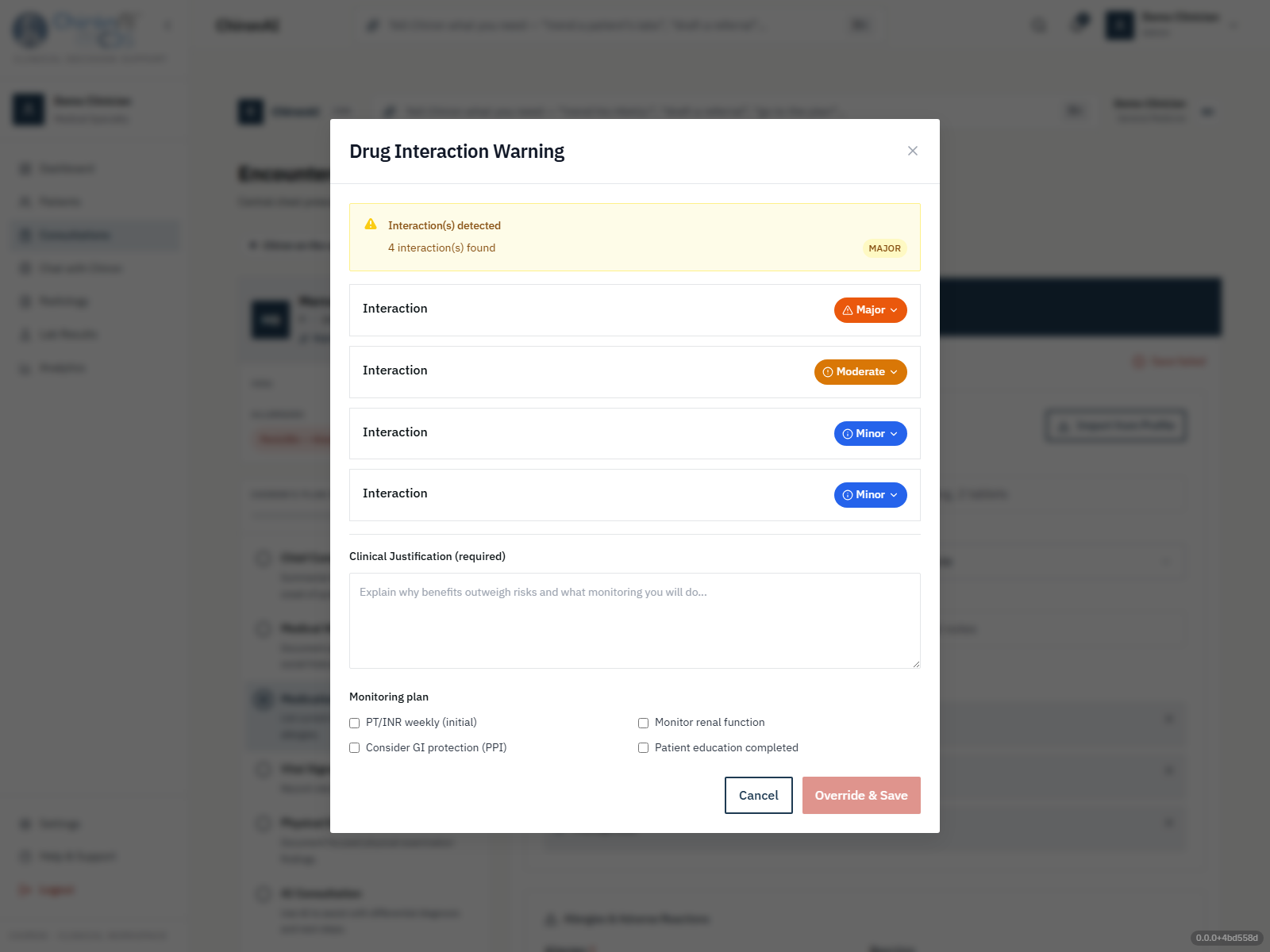
Safety screened before anything is drafted.
cds.chirongrid.ai
The CDS drug-interaction checker — four-tier severity with mechanism disclosure, step-therapy and prior-auth flags, anchored to the canonical pharmacology source.
The working medication list is checked before a plan is written — four-tier severity (critical, major, moderate, minor) with the mechanism disclosed and the pharmacology source that warrants each call. Step-therapy and prior-auth flags surface inline. RxNorm-anchored, with full medication context: indication, contraindication, and dose-adjustment guidance.
Ask Chiron

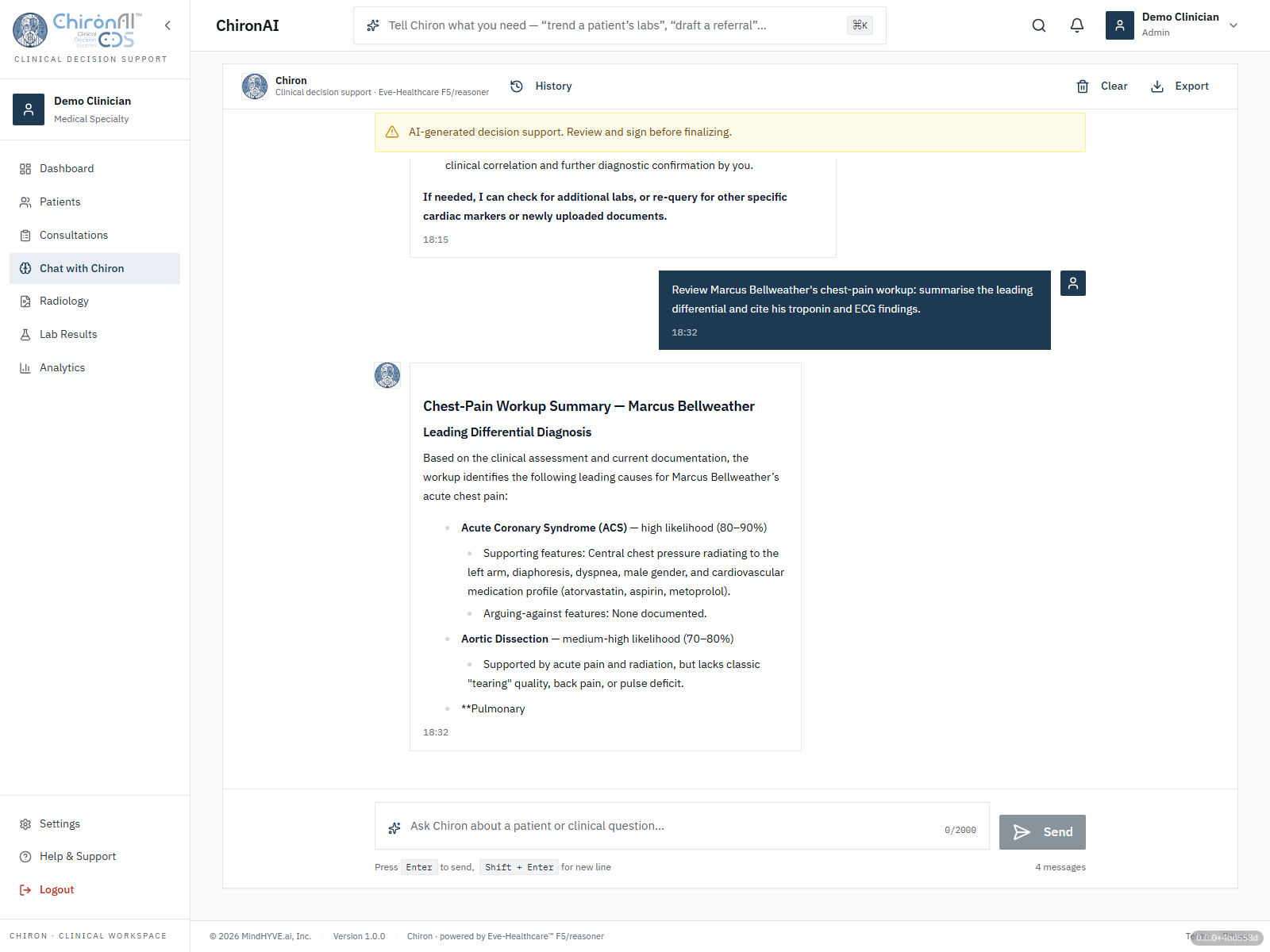
A copilot that shows its calls — and asks before it acts.
cds.chirongrid.ai
The Chiron copilot — answering in the patient’s context with visible, named tool-calls and an approval prompt before it acts on the chart.
The Chiron copilot knows your patients and can act across the chart through seventeen tenant-scoped, audited tools — but it surfaces the plan and the call it is about to make, and asks for your approval first. Bounded agency, by design. Decision support: the clinician decides, the AI reasons.
The cockpit

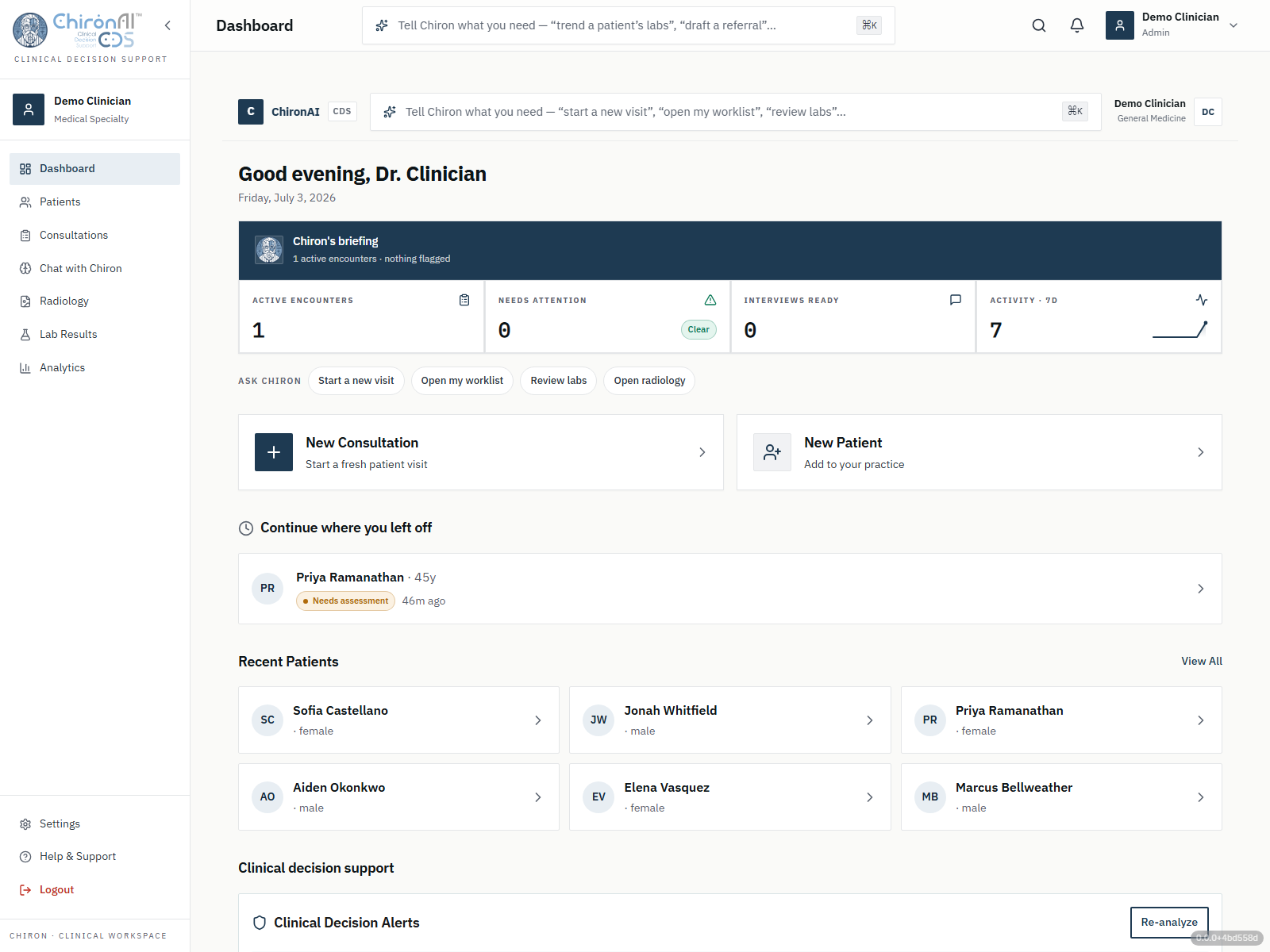
The day, curated into a working cockpit.
cds.chirongrid.ai
The CDS dashboard — a Chiron-curated clinical cockpit showing who needs attention, what is unsigned, and which studies are waiting to be read.
Chiron curates the day into a cockpit — who needs attention, what is unsigned, which reads are waiting — instead of a static list you triage yourself. For each patient it keeps a living snapshot: the priors, current results, and open questions that matter now, assembled from the record and kept current as the encounter moves.
Draft, then attest

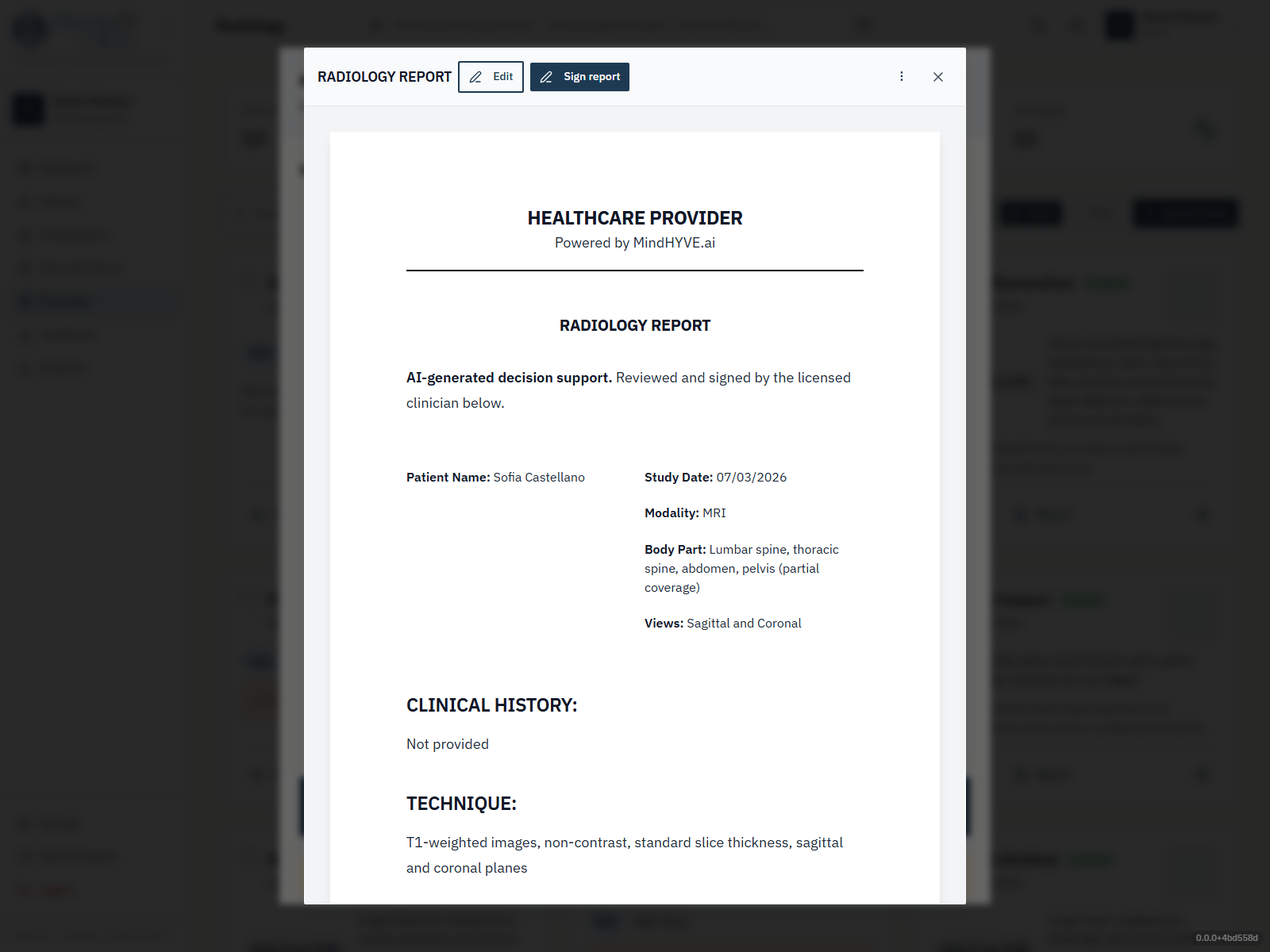
Nothing enters the chart until a physician signs it.
cds.chirongrid.ai
CDS draft-then-attest — a clinical artifact carrying the non-dismissible must-review-before-final banner, signed with an immutable SHA-256 hash at attestation.
Every AI artifact carries the non-dismissible must-review-before-final banner — the AB 489 gate, enforced on the server, not the browser. At signature each document gets an immutable SHA-256 hash; amendments are recorded as new versions and the original signed version stays verifiable. The signature is what makes it authoritative.
ChironAI™ OM · Occupational Medicineom.chirongrid.ai

Chiron runs the whole California claim.

Generally available and in production for California workers’-compensation practices. The statutory clocks, impairment math, apportionment offsets, and guideline retrieval run as deterministic, auditable engines — grounded in the actual California statutes, guidelines, and case law. The physician reviews the reasoning, edits, and attests.

The claim, at a glance

A decade-long claim, on one screen.

om.chirongrid.ai
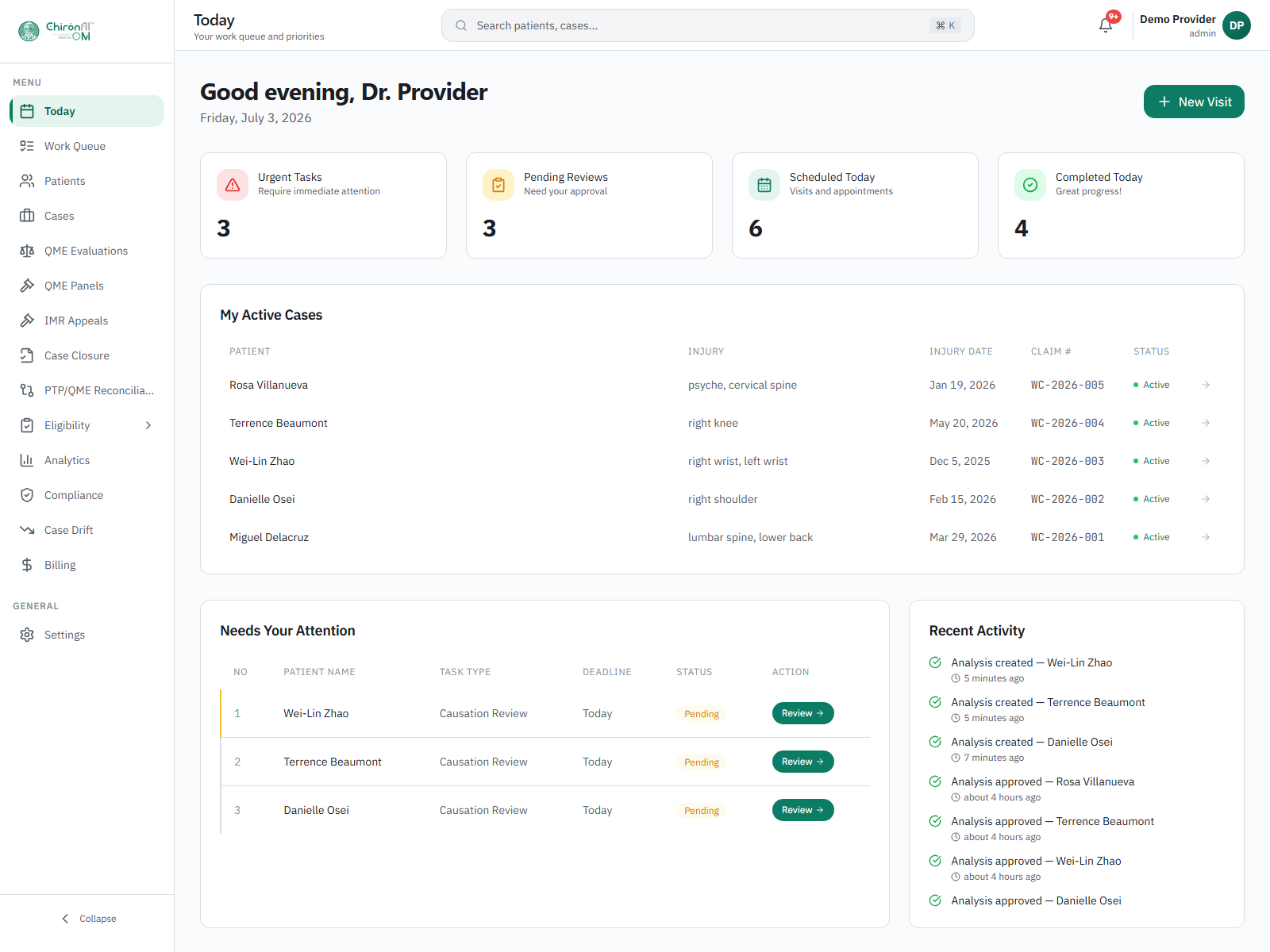
The OM dashboard — a workers’-comp claim at a glance, with lifecycle stage, statute-coded deadlines, and what needs attention next.
A California workers’-comp claim is a decade-long chain of medical, legal, regulatory, and financial decisions. ChironAI OM runs the whole chain in one system — eligibility, causation, treatment, utilization review, impairment, billing — and surfaces where each claim stands and which statutory clock is running down next.
AOE/COE causation

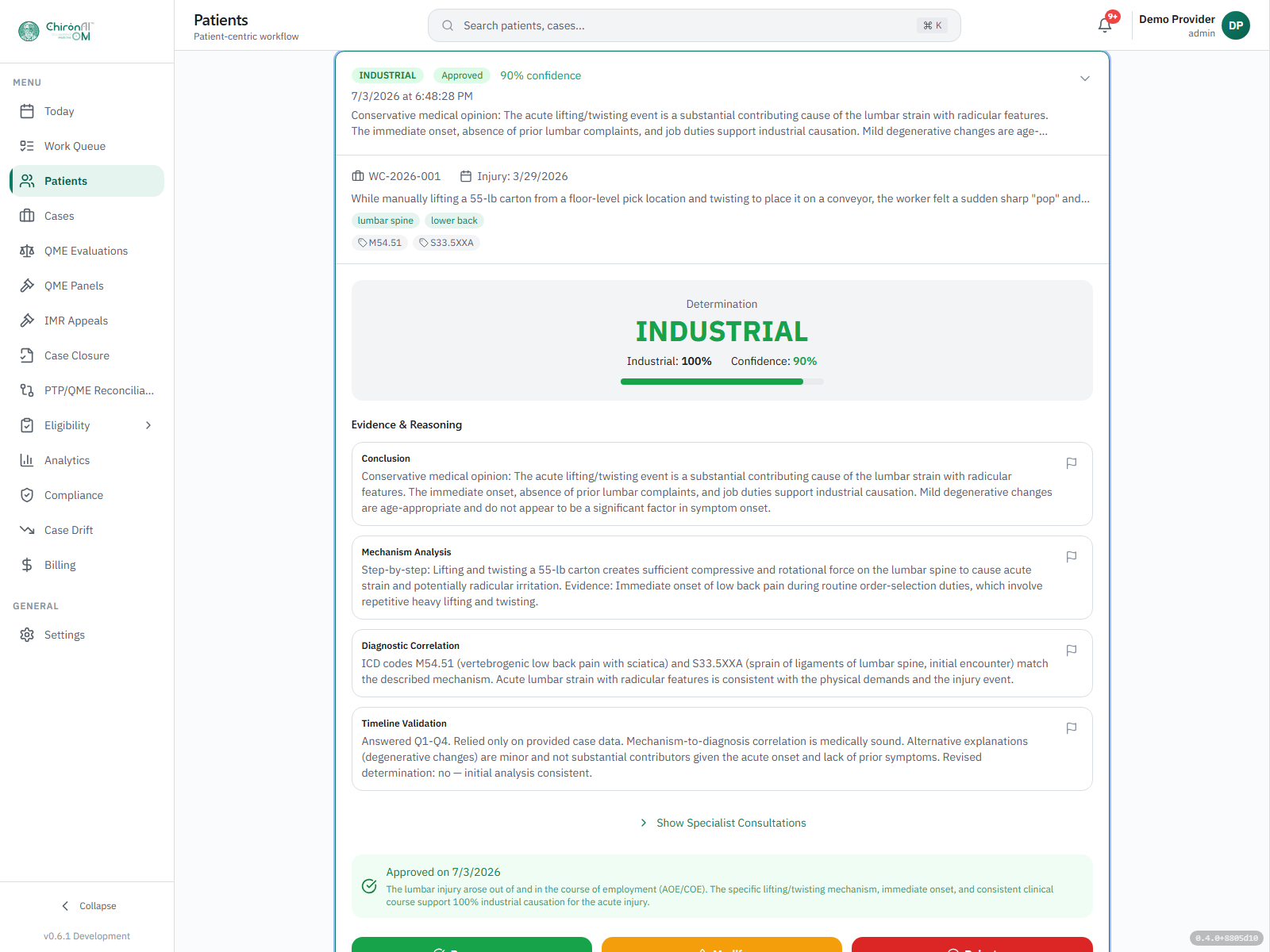
Work-relatedness, reasoned and physician-attested.
om.chirongrid.ai
The OM causation analysis — an AOE/COE determination under Labor Code §3600 with source-grounded reasoning, staged for physician attestation.
Chiron works the arising-out-of and course-of-employment question under Labor Code §3600, reasoning across the longitudinal history and consulting specialist Digital Employees by case — grounded in the controlling authority (Escobedo, Brodie, Strait, Hikida). Every analysis is versioned and audit-trailed; nothing is authoritative until the treating physician signs it.
Apportionment — §4663/§4664

The legal math is code, not a guess.

om.chirongrid.ai
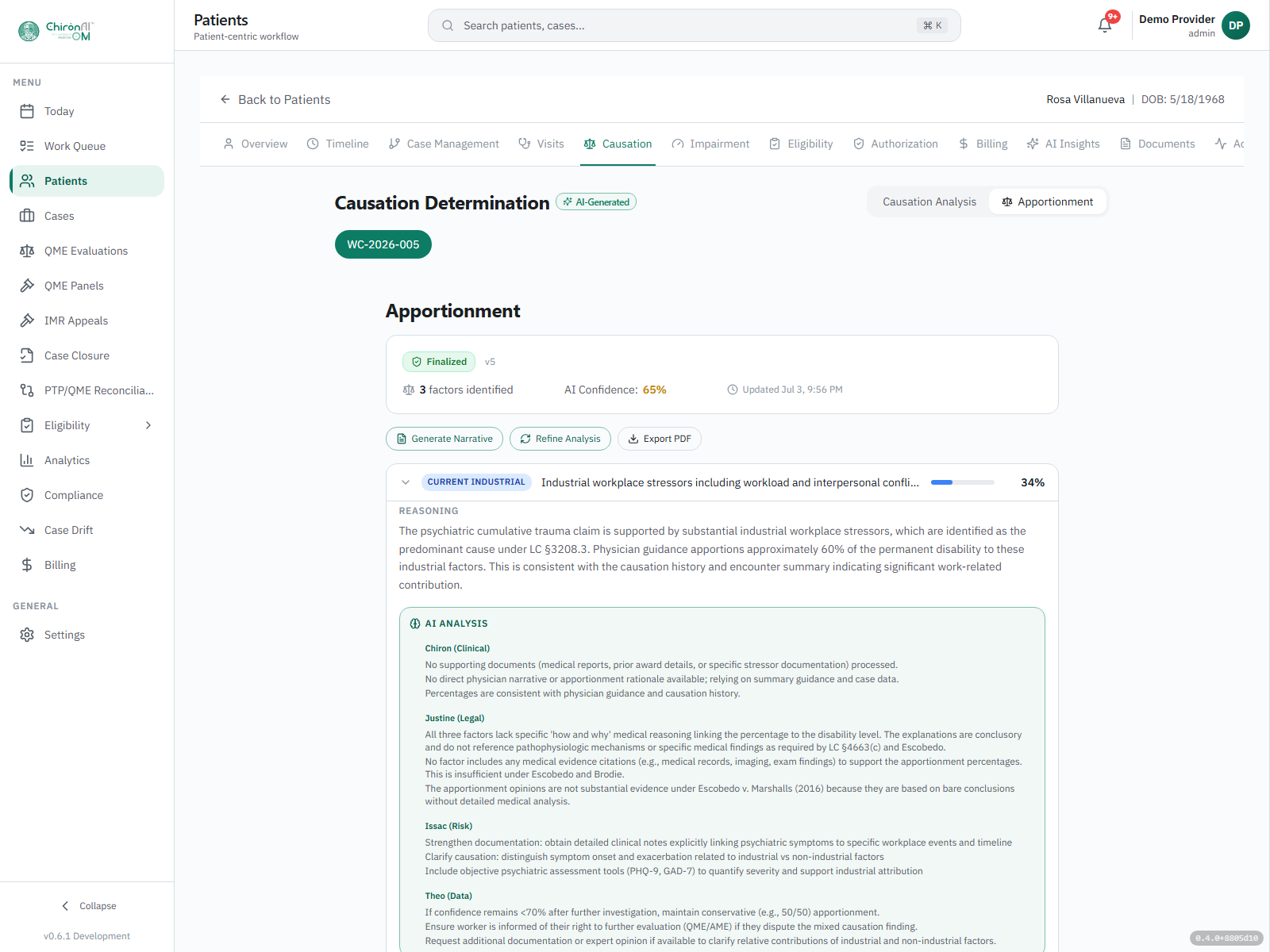
The OM apportionment view — an industrial vs non-industrial split under Labor Code §§4663/4664 with the §4664 prior-award offset computed deterministically.
Impairment combination (AMA Combined Values Chart) and the §4664 prior-award apportionment offset (Brodie / Strait) run as deterministic, auditable engines — the industrial and non-industrial split computed with the legal basis that defends each rating on cross-examination. Nothing that has to be exact is left to a probabilistic draft.
DWC reporting

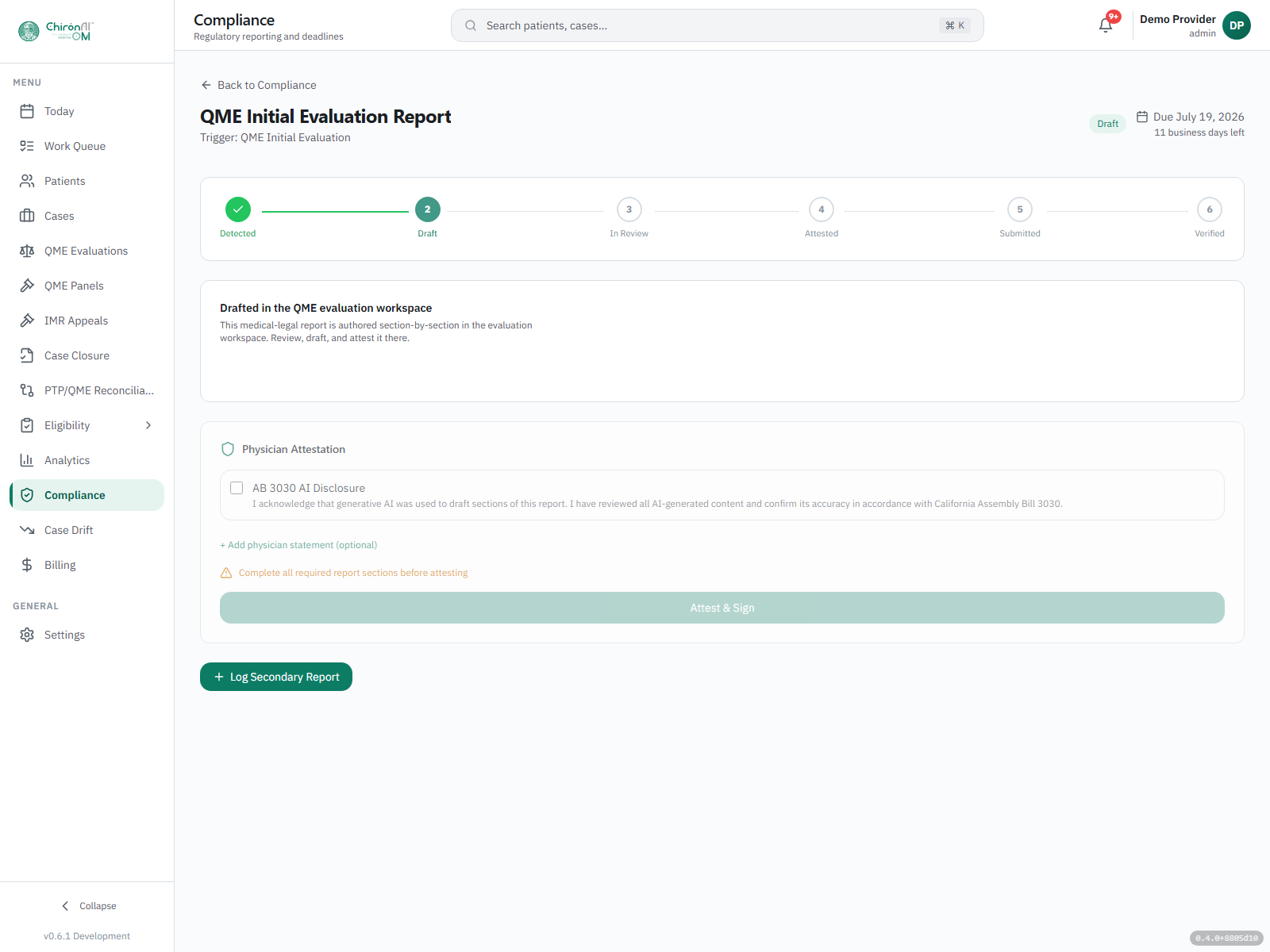
The DWC report, drafted from the record.
om.chirongrid.ai
An OM DWC report — a Form 5021 / PR-2 drafted from the case context with every field traceable to its source, carrying the AB 3030 disclosure.
The DWC report — Form 5021, PR-2, PS/MMI — is composed from the case context with every field traceable to the source that produced it. Deadlines compute against the California business-day and state-holiday calendar. Every AI-assisted report carries the non-dismissible AB 3030 generative-AI disclosure, and nothing is filed unattested.
QME evaluation

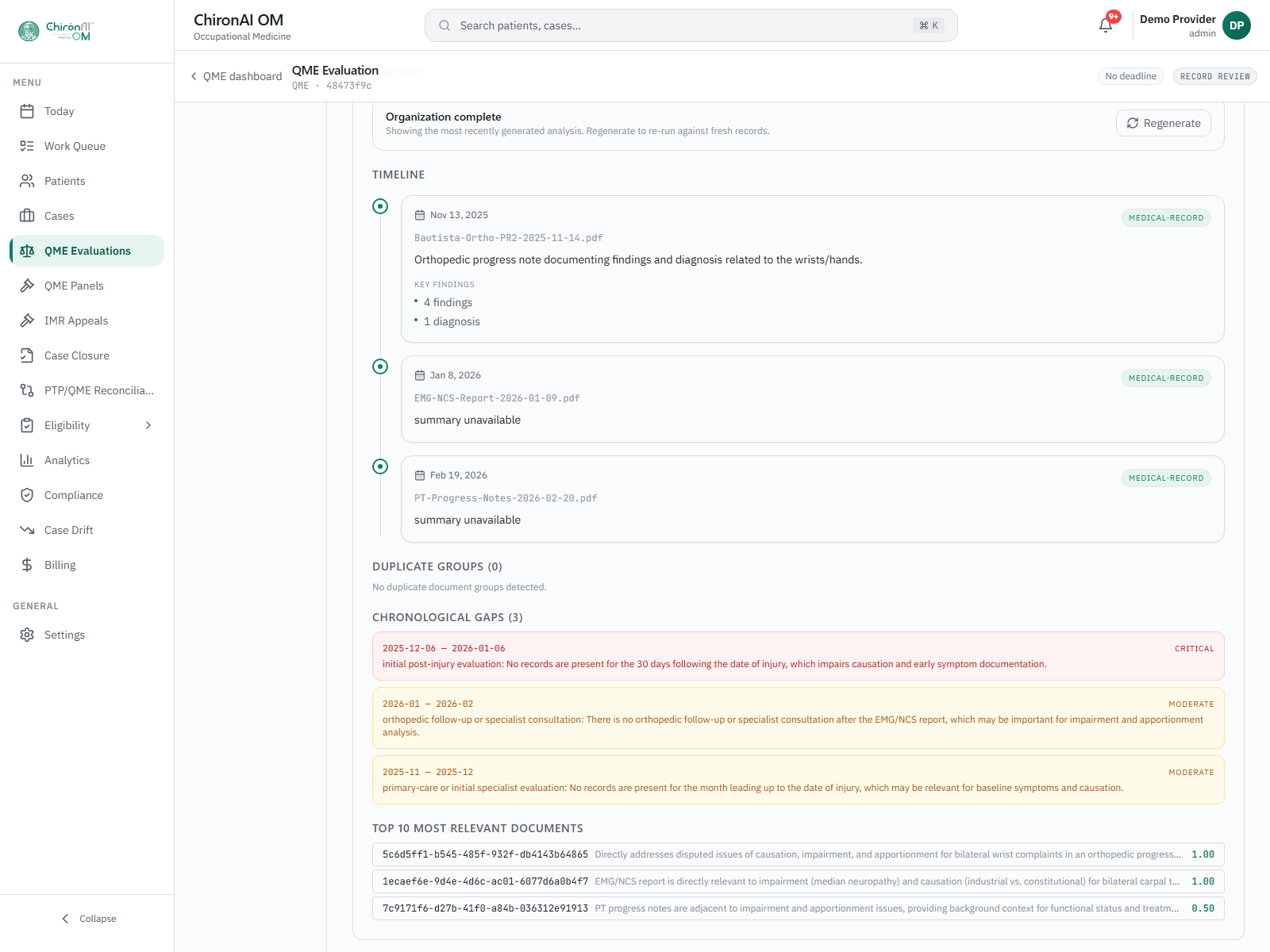
A structured QME report, section by section.
om.chirongrid.ai
The OM QME evaluation — a structured, section-by-section QME report with the §4062 panel process and evaluation timelines tracked through the QME machinery.
The QME evaluation is composed as a structured, section-by-section report, with the §4062 panel process and its evaluation timelines — including the §4062.5 thirty-day step — tracked through the QME machinery as a deterministic state machine. The result is deposition-ready: versioned, audit-trailed, and cryptographically verifiable.
UR / IMR survival

Score the RFA before it goes out.

om.chirongrid.ai
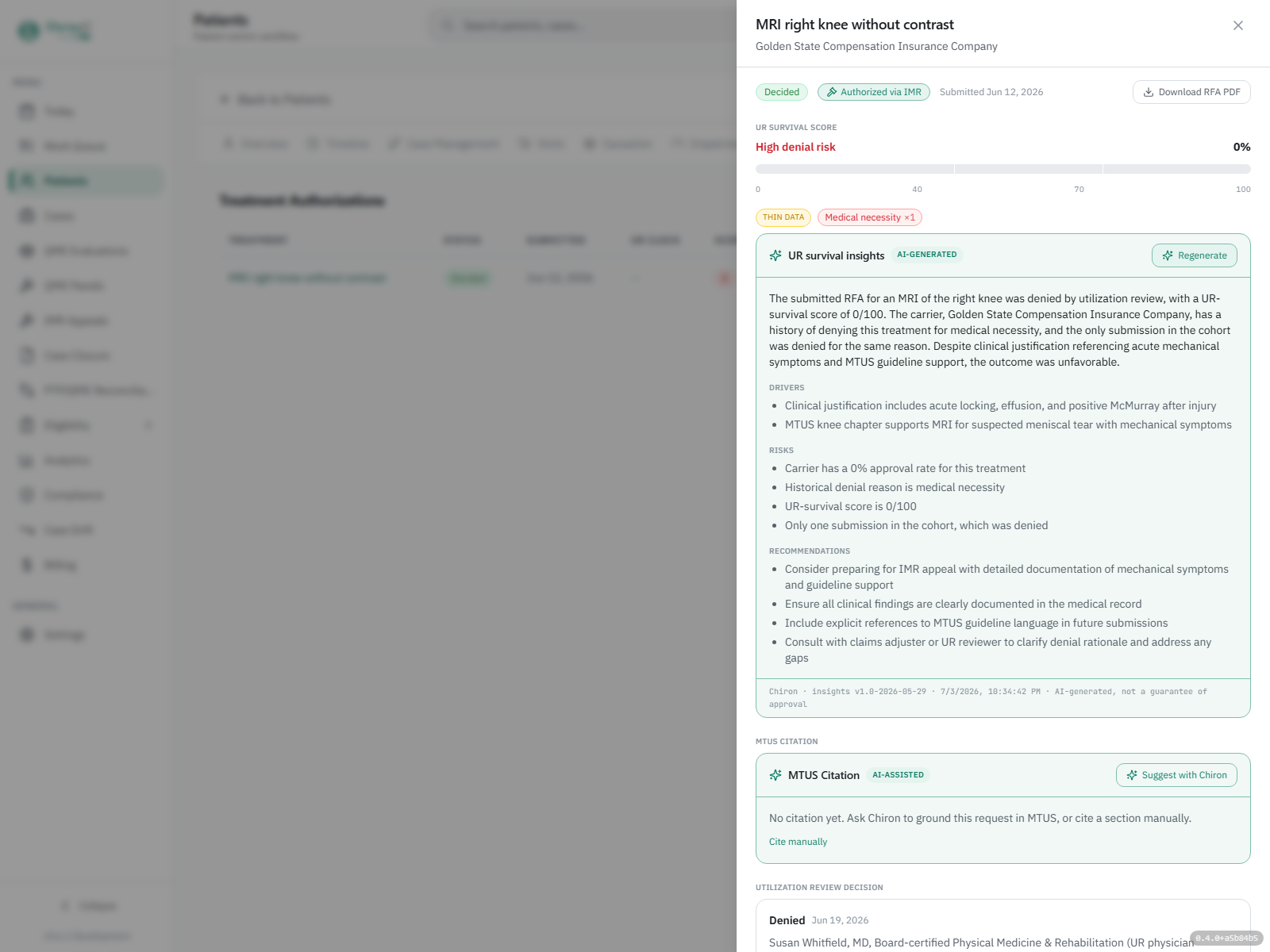
The OM utilization-review and IMR view — an RFA scored for denial risk before it goes out, with §4610 and §4610.5 timeframes tracked.
Before a Request for Authorization is submitted, ChironAI OM estimates denial probability and IMR-appeal exposure and names the evidence to attach so the request survives utilization review the first time. The §4610 UR timeframes (72 hours expedited, five business days standard, thirty calendar days retrospective) and the §4610.5 IMR clock are tracked to the day.
IMR appeal — §4610.5

When UR denies, the appeal is already staged.
om.chirongrid.ai
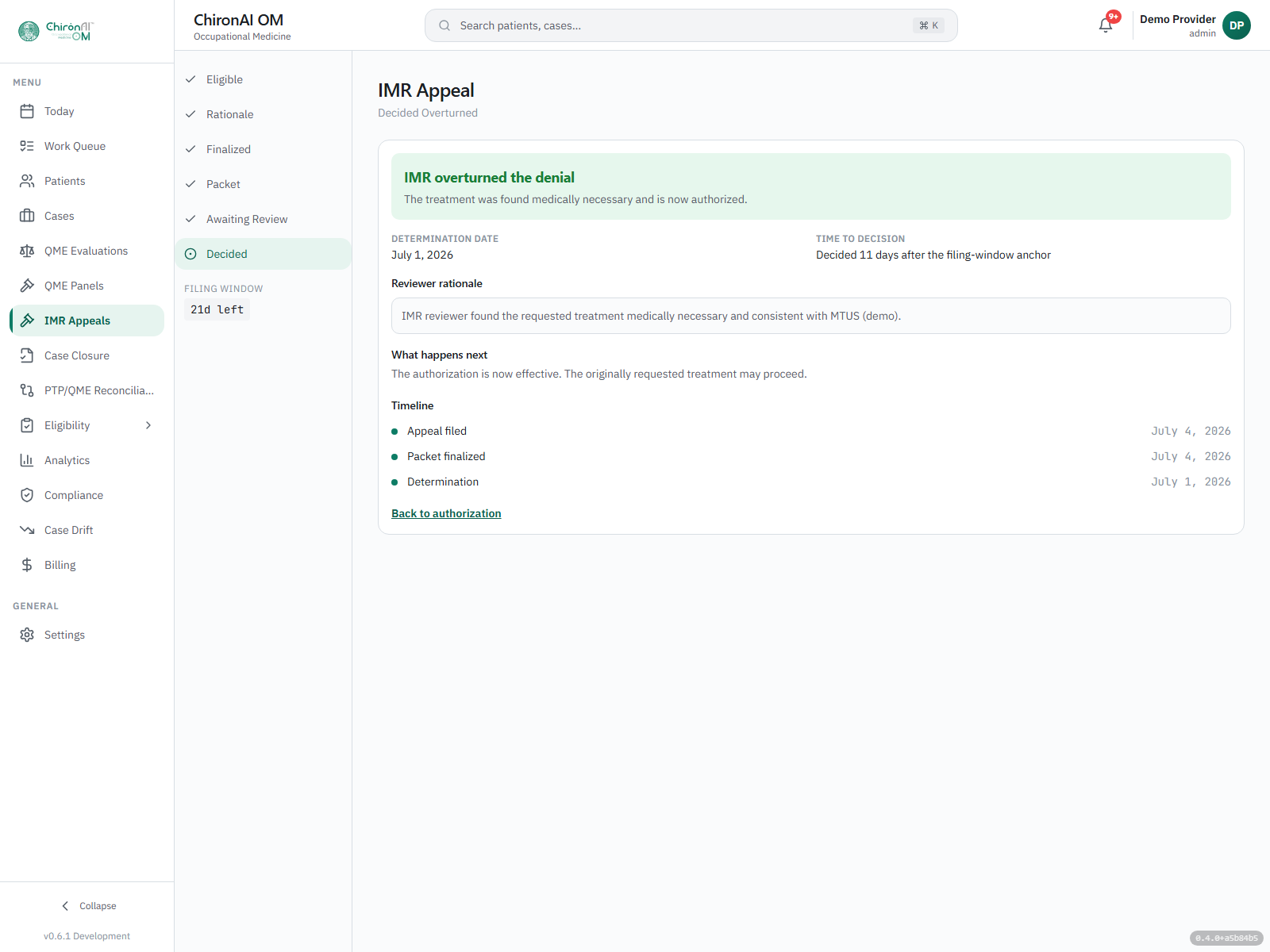
The OM IMR appeal workspace — a UR denial carried through the Independent Medical Review stage rail to a decided-overturned outcome, with the §4610.5 filing clock and the reviewer’s medical-necessity rationale.
A utilization-review denial doesn’t end the treatment — it starts the Independent Medical Review clock. ChironAI OM carries the appeal through every stage (eligibility, rationale, packet, review, decision) with the §4610.5 IMR filing window tracked to the day against the California state-holiday calendar. Here the denial was overturned: the treatment was found medically necessary and is now authorized, with the reviewer’s rationale on the record.
MMI & impairment

MMI on the clinical milestone, impairment on the Guides.
om.chirongrid.ai
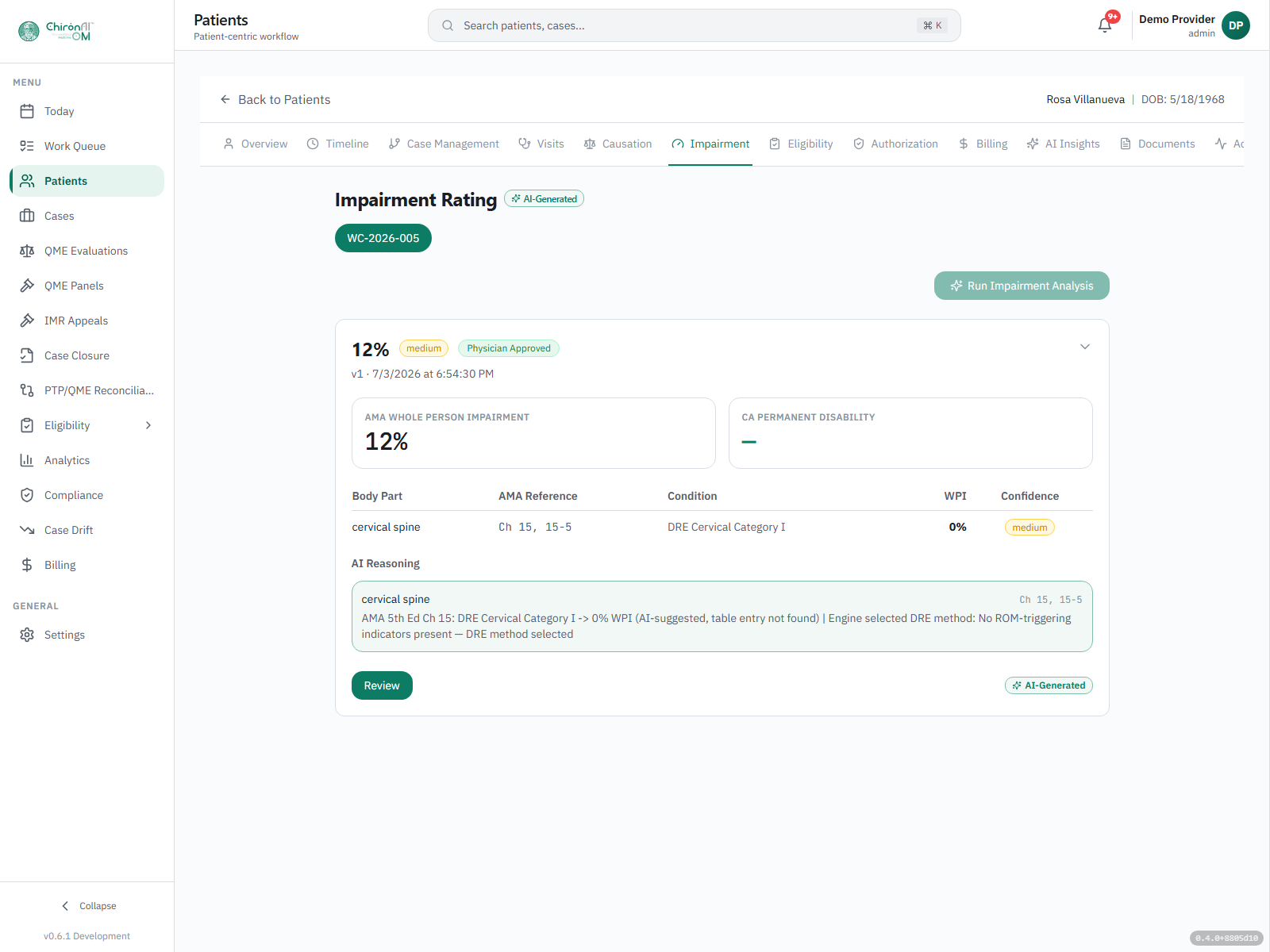
The OM MMI and impairment view — a Permanent and Stationary determination under §4061 with Whole Person Impairment rated under the AMA Guides 5th Edition.
Maximum Medical Improvement is declared on the clinical milestone and the Permanent and Stationary report is drafted under Labor Code §4061. Whole Person Impairment is rated under the AMA Guides 5th Edition — the California standard — with DRE/ROM method selection and the basis that defends each rating on cross-examination.
Billing & the pay clock

Coded to the fee schedule, timed to the statute.
om.chirongrid.ai
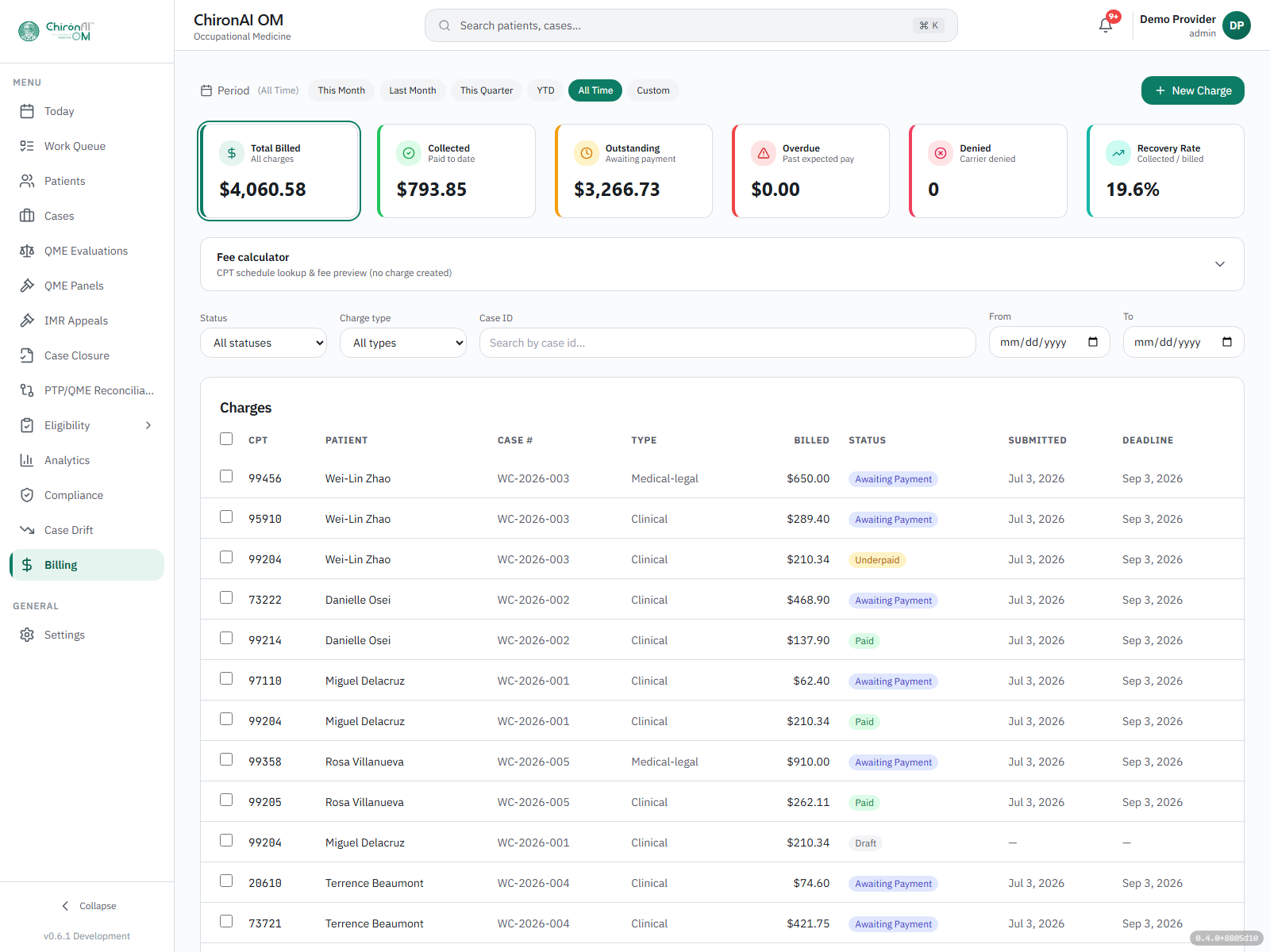
The OM billing view — OMFS-coded charges with the §4603.2 twelve-month filing window and 45-business-day payment clock, and a penalty-and-interest engine.
Charges are coded to the Official Medical Fee Schedule, with the §4603.2 twelve-month billing window and 45-business-day payment rule tracked per bill. When the pay clock is missed, the penalty-and-interest computation runs as a deterministic engine — the same inputs always produce the same result, with the derivation attached.
The whole caseload

Every claim in the practice, on one register.
om.chirongrid.ai
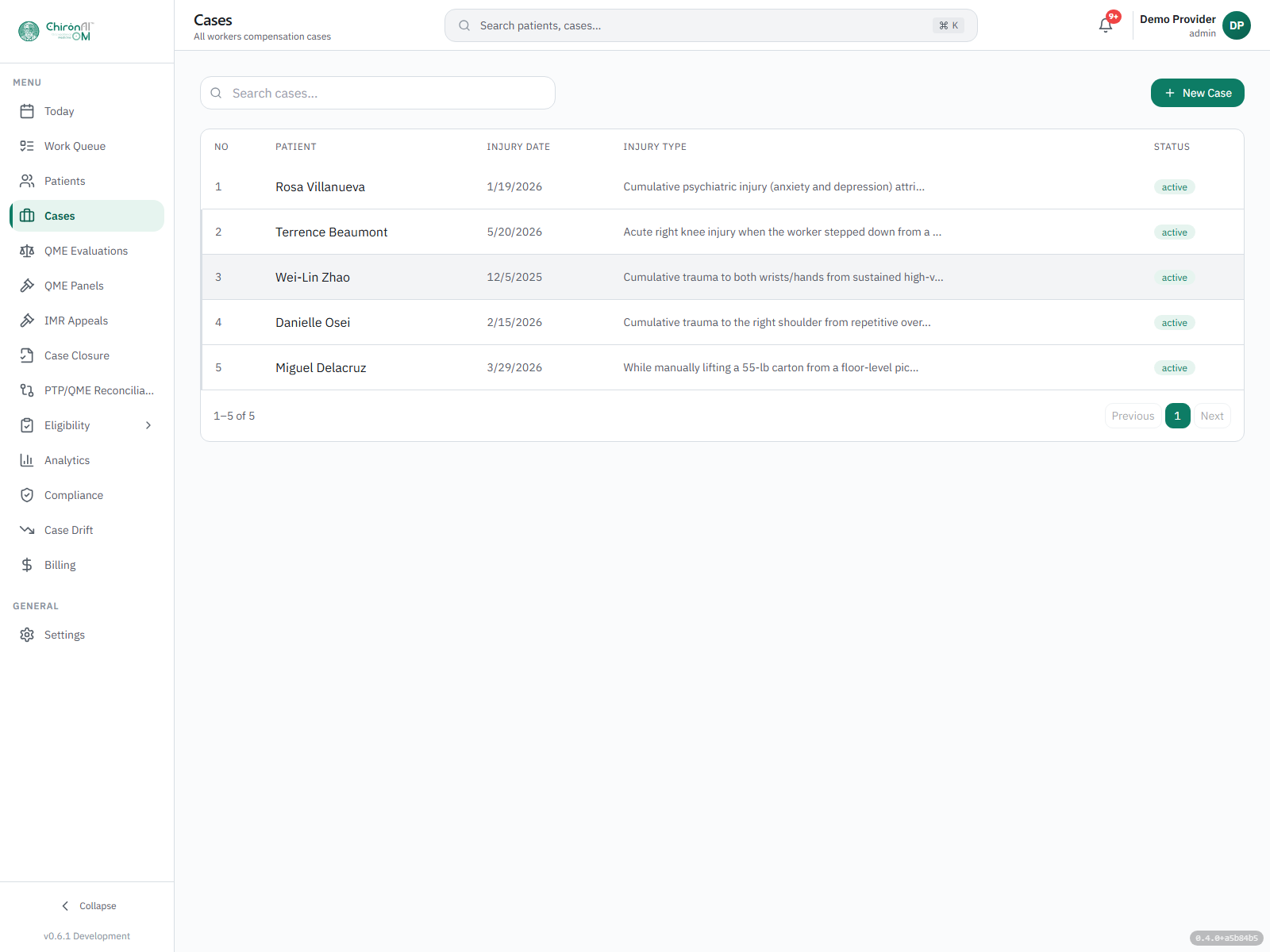
The OM caseload register — every workers’-comp claim in the practice on one screen, each with its patient, date of injury, injury type, and lifecycle status.
Every California workers’-comp claim the practice is carrying lives in one register — the patient, the date of injury, the mechanism, and where each claim stands in its lifecycle. From here Chiron opens any claim into its full workspace: causation, treatment authorization, QME, impairment, and billing, each grounded in the controlling statute and physician-attested.
A note to the reader

Every screen in this gallery shows synthetic data — no patient information. Captures reflect the live products on a synthetic demonstration record; individual features vary by edition and plan. ChironAI is decision support — the physician reads the reasoning, edits, and attests; the signature is what makes an output authoritative.