Decision support. Every determination on this page is structured for physician review before it reaches a payer, an attorney, or the chart. ChironAI OM reasons and ranks; the licensed physician signs. ChironAI does not make a regulatory clearance claim; see Disclosures.
Explainable AI. Not a black box.
ChironAI™ OM does not hand a physician a probability and ask for trust. Chiron leads the medical reasoning, convenes the specialist Digital Employees a case actually needs, self-critiques every finding before a human sees it, and shows its work at every step — the retrieval, the citation, the confidence, the dissent. Human-in-the-loop is not a policy statement here; it is the architecture. Nothing reaches a payer, an attorney, or the chart without a physician’s signature.
It convenes only the specialists a case actually needs.
Chiron leads every case. Issac, the utilization-review and audit-risk specialist, assesses denial risk on every case, no exceptions. Justine and Eli convene conditionally — apportionment or mixed causation calls Justine in, a billing dispute calls Eli in. Theo’s ethics-and-fairness seat opens automatically whenever Chiron’s own confidence drops below 70%. The seats run in parallel, and the case degrades gracefully — if a specialist times out, the determination proceeds with what came back and flags the gap rather than stalling.
Must review before final
Decision-support output. Clinician review and attestation required before this content is signed into the chart.
AOE/COE - industrial. The mechanism (floor-level lift, 65 lb) is consistent with the L4-L5 disc herniation newly demonstrated on the 2025-11-12 MRI and absent on the only prior lumbar imaging. Documented prior low-back episodes were transient with full work capacity between them.
Seats convened
- JustineLegal-evidence framingSeat opened
Consulted because the case raises apportionment.
Substantial-evidence standard met (Escobedo). Prior episodes were transient with full work capacity between - no basis for a §4664 prior-award offset. Apportionment to non-industrial cause is not supported on this record beyond documented degenerative change.
- TheoBias and fairness reviewSeat opened
Consulted because lead confidence is below the 70% review threshold.
No bias indicators. The determination rests on objective imaging and mechanism of injury, not demographic priors. Conservative-approach check passed; recommend documenting the negative 90-day non-industrial history explicitly.
- IssacUtilization-review / IMR riskSeat opened
Consulted on every case.
Denial / IMR-challenge probability low (~18%). Recommend attaching the MRI comparison and the negative non-industrial history to preempt a utilization-review challenge.
- EliFinancial / OMFS exposureSeat not needed
Consulted only when a billing dispute is present - not triggered here.
Not consulted: no billing dispute on this case. (When present, Eli analyzes OMFS alignment and denial-cost exposure.)
Not one model behind a prompt. A reasoning team, composed.
Every Round Table seat runs on Eve-Healthcare™ F5/reasoner — a compound, five-component reasoning architecture, not a single call to a single model. A classifier reads the case in milliseconds and decides what kind of reasoning it needs. A domain-tuned clinical reasoner, trained specifically on occupational-medicine and workers’-comp reasoning patterns, carries the bulk of the casework. Frontier reasoning slots activate for the cases that are high-stakes or genuinely ambiguous, with provider diversity built into the routing so no single upstream vendor is a single point of failure.
We do not publish which underlying models occupy which slot, for the same reason a hospital does not publish its EHR’s query planner: it is implementation, not a claim you should be reasoning about. What we do publish is what the architecture actually retrieves and cites — the 24 authentic California DWC MTUS/ACOEM guideline documents ingested and grounded against, refreshed on a standing cadence.
The composition is the point. A single model answering a workers’-comp question is a guess with confidence. Five components, each doing the part it is actually good at, checked against each other and against the guideline corpus, is closer to how a competent occ-med practice already works — it just runs in seconds instead of days.
Every specialist argues with itself before you do.
Before any finding is added to a draft, the specialist that produced it runs its own self-critique pass — the same three questions, every time, on every finding.
Initial
Apportionment to a non-industrial cause is not supported on this record beyond documented degenerative change.
Verification questions
- 1.Did I invent anything not in the record?
- 2.What would opposing counsel argue?
- 3.Would this survive cross-examination?
Final
Self-critique completeNo basis for a §4664 prior-award offset — prior episodes were transient, with full work capacity between them. Revised to document the negative 90-day non-industrial-event search explicitly, because the most likely challenge from opposing counsel is an unaddressed pre-existing condition.
Watch it think — for real.
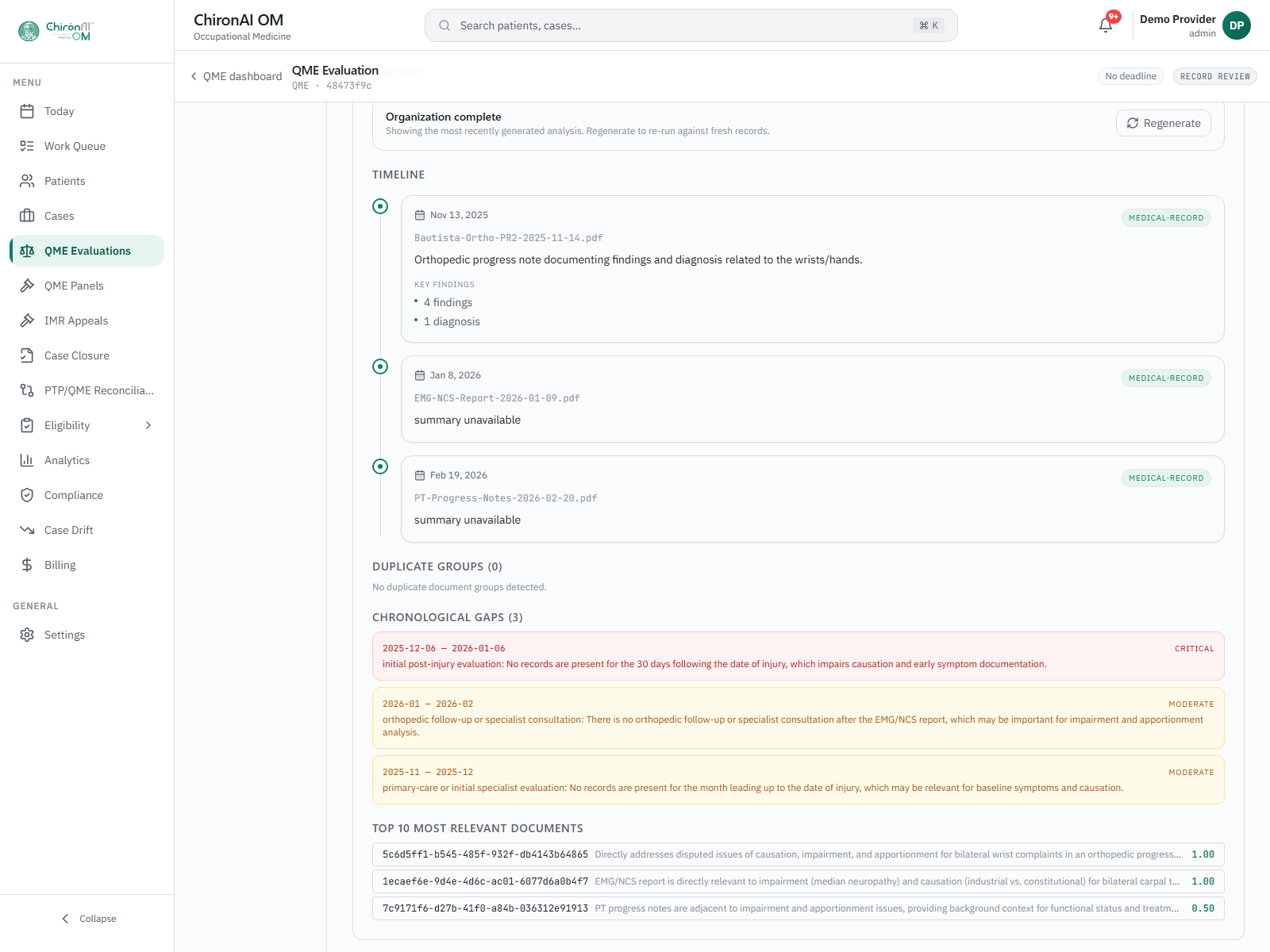
While the Round Table works a case, the physician sees a live trace of what is actually happening — which specialist is running, which guideline it retrieved, what it found. It is engineered to never fake a progress bar: if a source is slow or a specialist times out, the stream says so.
Routing · 0.1s
Classifier reads the case: causation plus apportionment, moderate complexity. Routes to the clinical reasoner and queues the specialist seats that might be needed.
Chiron · 2s
Retrieving MTUS/ACOEM guideline anchors for lumbar radiculopathy; comparing the 2025-11-12 MRI against the only prior lumbar imaging on file.
Justine · 1s
Checking the case against the Escobedo substantial-evidence standard and the Brodie/Strait line on apportionment.
Theo · 1s
Lead confidence reads 66% — below the 70% review threshold. Ethics and fairness seat opens automatically.
Issac · 1s
Running the pending RFA against MTUS conservative-care thresholds for denial risk.
Chain-of-Verification · <1s each
Every specialist finding above is self-critiqued before it is added to the draft.
Composed
Structured determination assembled from what came back. Nothing here is final until the physician signs it.
What never appears in that stream, or anywhere downstream of it: the private chain-of-thought each component uses internally to get to its finding. That scratch reasoning is not a transcript and it is not retained — only the structured finding and the citations behind it survive to the record.
It won’t invent an answer to sound helpful.
A physician can ask the case anything, in plain language. The answer is grounded only in the actual record and the guideline corpus — and a hard code guardrail deletes any citation the system did not actually retrieve, before the answer ever reaches the screen.
Question
Has the patient had any prior lumbar imaging before this injury?
Answer
The only prior lumbar imaging on file is a 2020 X-ray, and it did not show a disc herniation. (source: Radiology: X-ray, lumbar spine, 2020-06-14)
The 2025-11-12 MRI newly demonstrates an L4-L5 disc herniation that is not present on that prior film. (source: Radiology: MRI, lumbar spine, 2025-11-12)
The same discipline runs on every case, not just Q&A: an ICD-10 hallucination guard checks every generated diagnosis code against the real code set before it reaches a claim form, and apportionment citation validation confirms that every case-law citation in an apportionment analysis resolves to a real, checked authority.
It attacks its own determination first.
Before an RFA goes out, Defend This runs the case the way the opposition will — as the defense QME, the UR reviewer, the carrier — and argues against Chiron’s own conclusion. It tallies what it can already answer, what needs attention, and what is genuine exposure, then builds a submit-ready defense packet from what holds up.
Must review before final
Decision-support output. Clinician review and attestation required before this content is signed into the chart.
6
Answered — the record already covers the likely objection.
2
Manage — fixable before submission, not yet fixed.
1
Exposure — a real gap the record does not close.
- Objection — has conservative care been tried and failed? Answered: six documented weeks of chiropractic care and NSAIDs preceded the imaging referral.
- Objection — does the new imaging finding actually change management? Answered: the herniation was absent on the only prior film and changes the surgical-candidacy discussion.
- Manage — no home-exercise-program compliance log on file. Add before submission.
- Exposure — no electrodiagnostic (EMG/NCS) correlation on file yet. A carrier could argue the radiculopathy is not objectively documented.
The packet only includes what actually holds up. The Exposure item stays visible — not hidden — until it is resolved.
Run the numbers before you file. No new AI opinion required.
What-If is a calculator, not a reasoning engine: instant scenario modeling that runs deterministic math over the case’s existing AI-derived findings and the Labor Code constants that govern the payout — the same inputs always produce the same number.
Regular work offered within 60 days
$8,700
10% final PD × $870/point
No qualifying work offer within 60 days
$12,180
10% final PD × $870/point × 1.4 (§4660.1)
Exact, deterministic arithmetic over the case’s existing finding — not a new opinion from the reasoning engine.
Know the denial risk before the payer does.
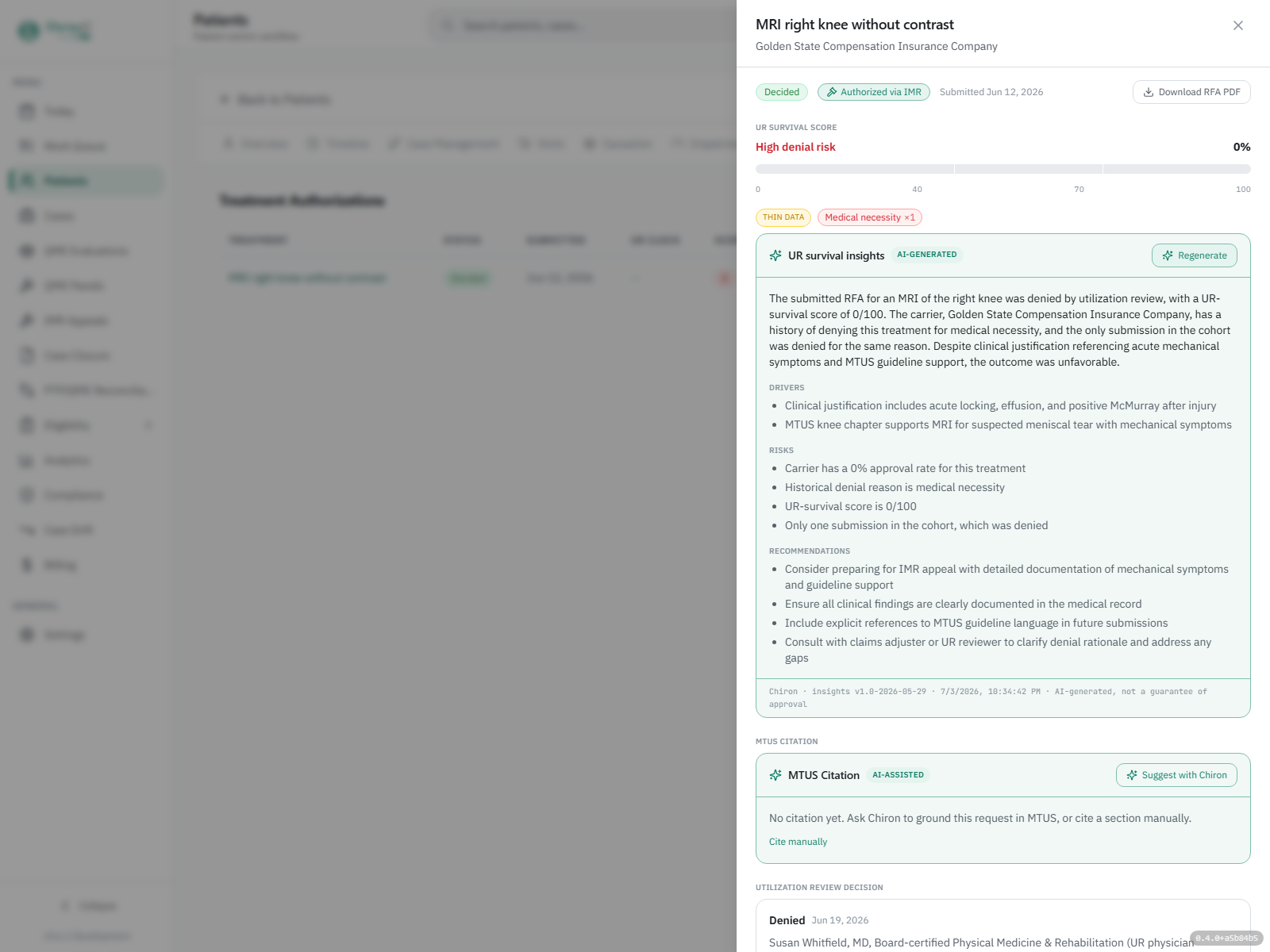
Before a request for authorization goes out, Issac scores how likely it is to survive utilization review the first time, estimates the downstream IMR-appeal risk, and names the evidence to attach to close the gap.
Must review before final
Decision-support output. Clinician review and attestation required before this content is signed into the chart.
Standard utilization review: 5 business days (§4610). Expedited: 72 hours if urgent.
UR Survival Score
78/100
Denial probability
22%
IMR appeal risk
11%
What drives the score
- MTUS supports physical therapy for acute radiculopathy - a strong guideline anchor.
- MRI is justified by failed conservative care plus objective neurologic findings.
- Attach the MTUS citation and the objective exam findings to the RFA to preempt denial.
Chiron proposes the rating. The engine decides the number.
Chiron reads the exam findings and proposes a candidate Whole Person Impairment rating under the AMA Guides, 5th Edition — the California standard. The AMA Combined Values engine and the 2005 PDRS calculation chain (FEC, age, occupation adjustment, final PD) then run as separate, deterministic, versioned code. The candidate is a starting point; the engine’s output is what reaches the report — and when the two ever diverge, the engine’s number wins, every time.
Must review before final
Decision-support output. Clinician review and attestation required before this content is signed into the chart.
Chiron’s candidate
8% Whole Person Impairment
Engine-verified
8% Whole Person Impairment
DRE Lumbar Category II · AMA Guides to the Evaluation of Permanent Impairment, 5th Edition (the California standard).
Calibration you can measure, not a promise you take on faith.
Case Drift flags claims that are lagging their own expected recovery trajectory against the guideline the treatment plan is anchored to. And every physician edit, override, and signature is compared back to Chiron’s original draft, so the system tracks how often physicians actually agree with it — a live calibration signal, not a marketing number.
Case Drift flagged
Expected modified-duty return by week 6 under the MTUS low-back radiculopathy guideline. Still not cleared at week 9.
Physician-agreement rate
84% · trailing 90 days
Share of causation determinations signed with no substantive edit to Chiron’s original finding.
The Round Table reasons. The physician signs.
The Round Table takes initiative — it convenes the right specialists, self-critiques its own findings, scores the denial risk, argues against its own conclusion before you do. It never crosses into deciding. Physician review-and-override sits at the API layer, not as an afterthought: deterministic engines override the AI on every number that matters, and the IMR-eligibility classifier is built to fail open, so an ambiguous case never silently costs a worker their appeal window. Once a physician signs, the document is cryptographically verifiable against a public endpoint — provably unaltered since attestation. Human-in-the-loop is not a policy on top of the system here. It is the system.
Read: agency, not autonomy →