The 15% you are owed and never bill for.
When a carrier pays a treatment bill late, Labor Code §4603.2 does not ask anyone’s permission. The amount is increased by 15 percent, with interest at the civil-judgment rate, retroactive to the day they received the itemization. Medical-legal bills carry their own: §4622, a 10 percent penalty and 7 percent interest. Both are self-executing.
Almost nobody collects it, because collecting it means knowing the exact date a properly documented bill was received, counting calendar days rather than business days, and doing that for every charge in the practice. That is not a discipline problem. It is a bookkeeping problem, and it is the kind of problem software is actually good at.
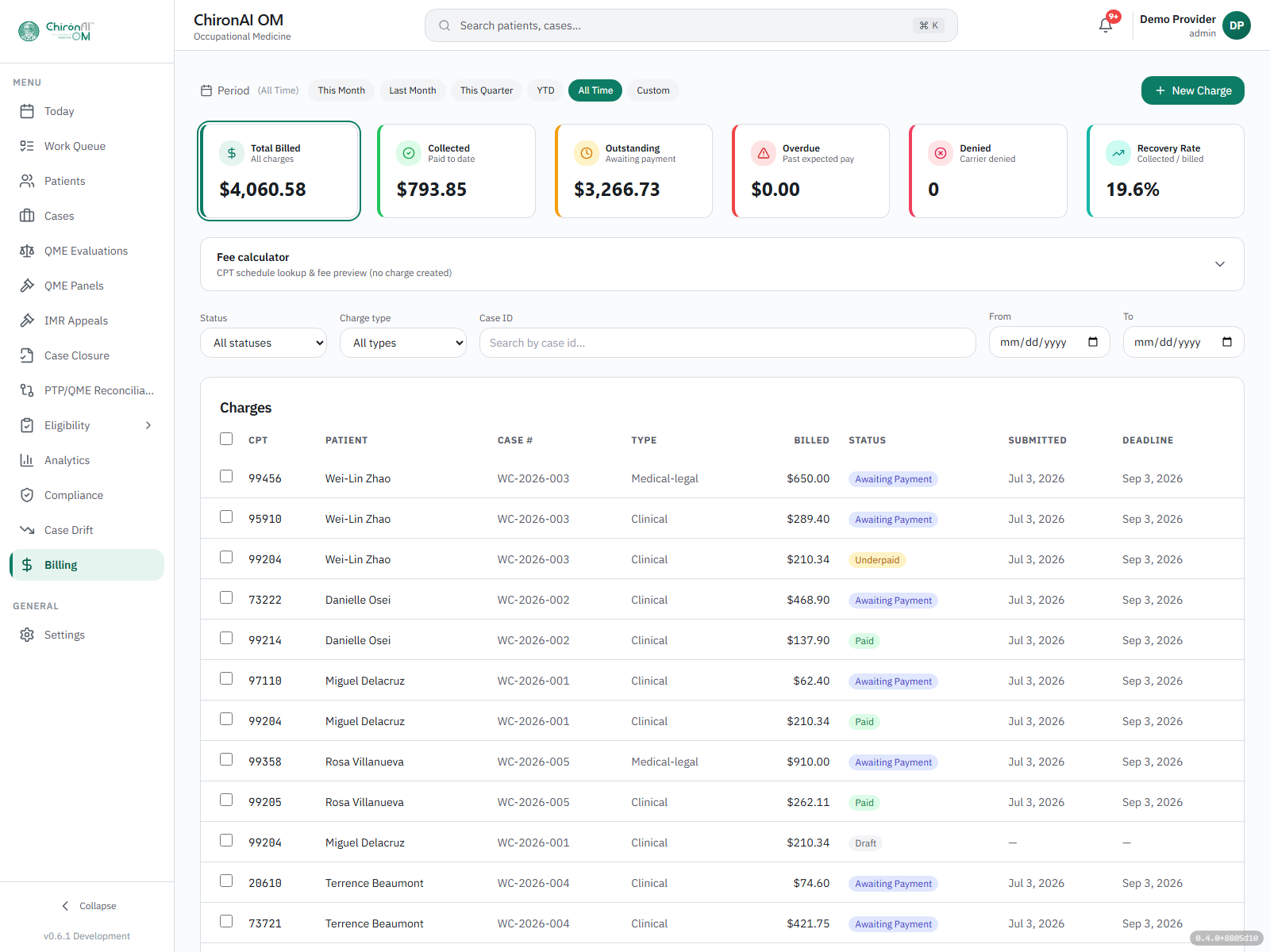
Two clocks, two entitlements, both in calendar days.
| Bill type | Payment due | If late | Interest |
|---|---|---|---|
Treatment bill LC §4603.2 | 45 calendar days | 15% increase | 10% per annum, retroactive to receipt civil-judgment rate, CCP §685.010 |
Medical-legal bill LC §4622 | 60 calendar days | 10% penalty | 7% per annum self-executing |
Treatment bill
- 45calendar daysCarrier must payfrom receipt of the itemizationLC §4603.2
- 90calendar daysSecond review+5 days when the EOR was served by mailDWC Form SBR-1
- 30calendar daysIndependent Bill Reviewfrom the final second-review determinationDWC Form IBR-1
165 days end to end, drawn to scale. The window to dispute is longer than the window the carrier had to pay — and the last one is the shortest.
Medical-legal bill
- 60calendar daysCarrier must payfrom receipt of a properly documented billLC §4622
- 90calendar daysSecond review+5 days when the EOR was served by mailDWC Form SBR-1
- 30calendar daysIndependent Bill Reviewfrom the final second-review determinationDWC Form IBR-1
180 days end to end, drawn to scale. The window to dispute is longer than the window the carrier had to pay — and the last one is the shortest.
The §4603.2 clock was counted in business days in an earlier build of this product and corrected to calendar days on 13 September 2026. We mention it because the difference is roughly two weeks per charge, and because a vendor who will not tell you what they got wrong is not telling you much.
Charge to collection, with the dispute path built in.
- 01
Charge capture and fee calculation
OMFSCharges are built from the encounter that produced them, priced against the Official Medical Fee Schedule, and carry the documentation that supports the level billed.
Procedure coding and E/M level scoring run on the note the physician actually wrote, so the code and the chart agree before the bill leaves.
- 02
Submission and payment tracking
§4603.2 · §4622Every charge carries its own clock from the date the carrier received a properly documented bill — 45 calendar days for treatment, 60 for medical-legal.
Calendar days, not business days. That distinction was corrected in the product on 2026-09-13 and it moves real money.
- 03
EOR ingestion — extract, then confirm
Explanation of ReviewUpload the EOR. It is read, the adjustments and denial reasons are extracted line by line, and the proposed posting is put in front of a human.
Nothing is ever auto-posted. The extraction is a proposal a person confirms or discards — the same discipline the product applies to every AI-derived write.
- 04
Second review
§4622(b)(1) · SBR-1Ninety calendar days from service of the EOR, plus five when it was served by mail. The form is DWC Form SBR-1 and the deadline is computed, not remembered.
A disputed charge that misses this window is finished. The clock starts on service, which is why the mail rule is in the calculation rather than in a footnote.
- 05
Independent Bill Review
§4603.6 · IBR-1Thirty calendar days from the final second-review determination, on DWC Form IBR-1.
The chain is enforced in order: IBR is only reachable from a resolved second review, which is the sequence the statute requires.
- 06
Late-payment penalty and interest
§4603.2 · §4622Self-executing. If the carrier paid late, the penalty and interest are owed by operation of law — and the system calculates them per charge.
This is the line most practices never bill. It is not a dispute and it is not a negotiation; the statute says the amount is increased.
Reading an EOR is not a judgement call. Deciding what to do about it is.
Extraction, then a human
The EOR is read and its adjustments and denial reasons are pulled out line by line. The result is a proposed posting. Nothing reaches the ledger until a person confirms it, and discarding it is a first-class action rather than a workaround.
Denial analysis and appeal drafting
A denial is classified, the second-review argument is drafted against the reason actually given, and the SBR-1 is populated. The physician decides whether it is worth filing; the system makes sure the window has not closed while they decide.
Coding that matches the chart
Procedure coding and E/M level scoring run against the note the physician wrote, not against a template. A level the documentation will not support is a downcode later and an audit finding at worst.
Authorization that survives review
An RFA is drafted against MTUS and scored for whether it is likely to survive utilization review before it is sent. An RFA that comes back denied is three weeks of treatment nobody delivered and nobody billed.
Bring one month of EORs to the demo.
We will walk the money path on your own paper — what was paid late, what the statute entitles you to on it, and which denials still have a live second-review window. That is a more useful forty minutes than any slide we could show you.
Book a demo